

If you’re interested in professional dryer vent cleaning, learn more about Orion Cleaning Solutions’ dryer vent cleaning service.
Table of Contents
How often should dryer vents be cleaned? For many homes, once a year is a useful baseline, but the right timing depends on the dryer, the vent configuration, how frequently it is used, and whether signs of restricted airflow appear sooner.
The U.S. Fire Administration recommends cleaning dryer vent ductwork every year, while the U.S. Consumer Product Safety Commission also advises homeowners to clean lint from the vent pipe at least annually. Both agencies emphasize keeping dryer exhaust systems clear because lint buildup and restricted airflow can contribute to dryer-fire hazards.
That does not mean every dryer should automatically wait exactly 12 months between cleanings.
A large household doing laundry every day may accumulate lint differently from a home where the dryer runs only a few times per week. A long exhaust run with several turns can also behave differently from a short, direct vent to an exterior wall.
More importantly, certain warning signs can indicate that the vent should be inspected or cleaned before the normal annual interval.
If you’re wondering how often should dryer vents be cleaned, the answer should take both annual maintenance and the actual performance of the dryer into account.
Here are seven warning signs to watch for and the factors that can affect your home’s dryer vent cleaning schedule.
Why Dryer Vent Cleaning Matters
A clothes dryer needs to move warm, moist air from the appliance through the exhaust duct and out of the home.
During normal drying, the lint screen captures much of the lint released from clothing, but it does not necessarily capture everything. Some material can travel into the exhaust system over time.
As lint and other debris accumulate, airflow through the vent can become restricted.
The U.S. Consumer Product Safety Commission warns that lint can build up in dryers and exhaust ducts, block airflow, contribute to excessive heat buildup, and create a fire hazard.
The U.S. Fire Administration similarly advises homeowners to clean the dryer vent ductwork every year in addition to cleaning the lint filter every time the dryer is used.
Those recommendations help explain why dryer vent maintenance should not be treated as an optional task that is only considered after the dryer stops working properly.
When deciding how often should dryer vents be cleaned, annual maintenance provides a useful starting point, but changes in drying performance can indicate that the system deserves attention sooner.
So, How Often Should Dryer Vents Be Cleaned?
For many households, having the dryer vent checked and cleaned approximately once per year is a sensible starting point.
However, how often should dryer vents be cleaned depends on more than the calendar.
A home may need more frequent attention when:
- The dryer is used very frequently
- Several people share the same dryer
- The exhaust duct is unusually long
- The duct contains multiple bends
- The exterior vent is difficult to access or monitor
- Drying times have increased
- Airflow from the outside vent appears weak
- Lint has accumulated around the vent opening
- The dryer has not been cleaned in several years
The most important rule is not to ignore symptoms simply because the last cleaning was less than a year ago.
If drying performance changes or the vent appears restricted, that is worth investigating.
In other words, the best answer to how often should dryer vents be cleaned is generally once per year as a baseline, with earlier attention when the dryer or exhaust system shows signs of a problem.
1. Clothes Are Taking Longer to Dry
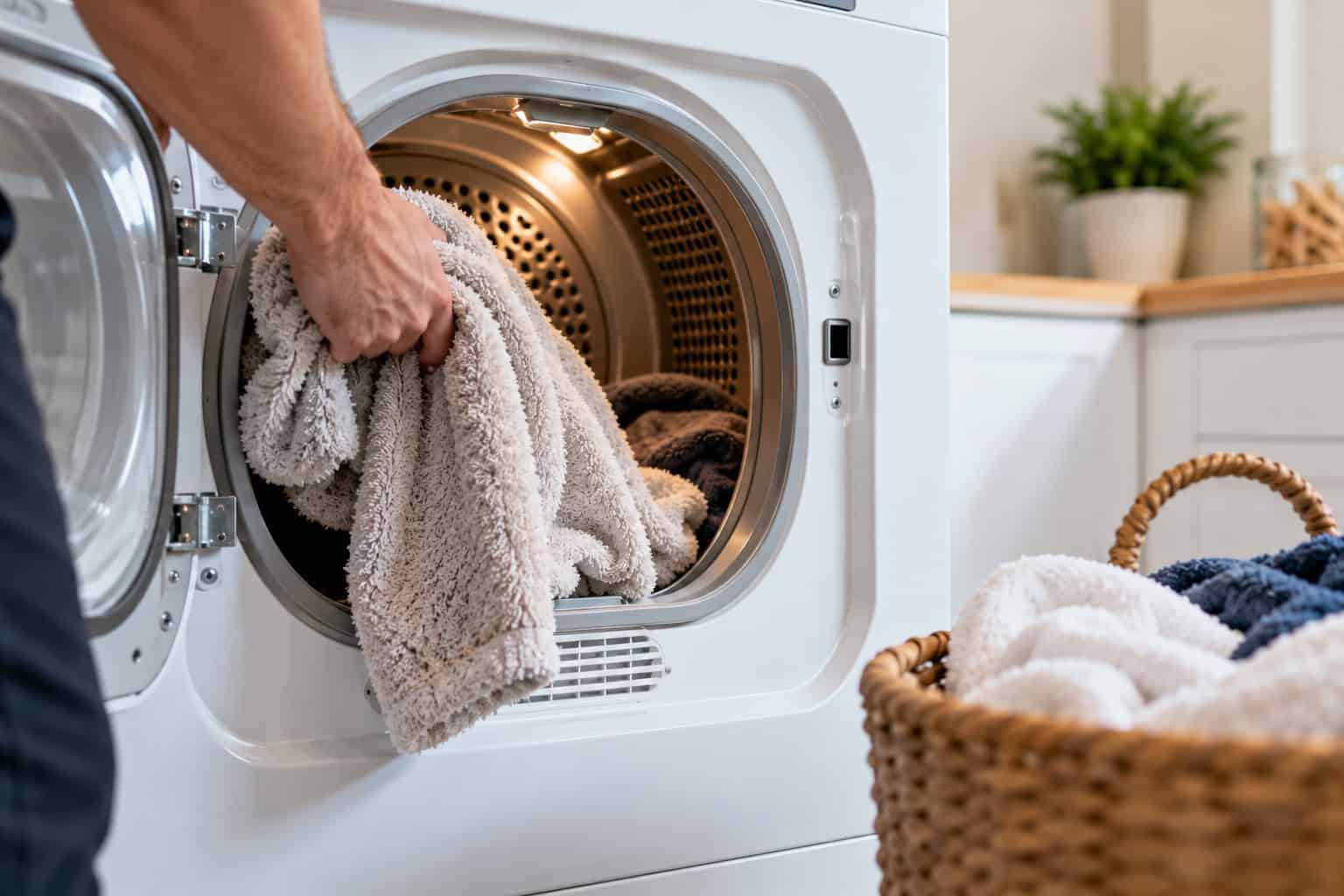
One of the most recognizable signs of a possible dryer vent problem is an increase in drying time.
A load that previously dried during a normal cycle may suddenly require another cycle or remain noticeably damp.
The CPSC specifically notes that clothes remaining damp after a typical drying cycle—or requiring longer than normal to dry—can be a sign that the lint screen or exhaust duct is blocked.
There can be other reasons for poor dryer performance, so longer drying time does not automatically prove that the vent is clogged.
However, it is an important warning sign.
If you’re asking how often should dryer vents be cleaned because your dryer now needs substantially longer to dry the same type of load, it may be better to have the vent evaluated rather than simply waiting for the next scheduled annual cleaning.
Restricted airflow can make it more difficult for warm, moisture-filled air to leave the dryer efficiently.
What to Check First
Before assuming the exhaust duct is the problem:
- Clean the lint screen.
- Make sure the dryer is not overloaded.
- Check whether the correct drying cycle is being used.
- Inspect the exterior vent while the dryer is operating, if it can be done safely.
If the issue continues, the exhaust path may deserve further attention.
2. Airflow at the Exterior Vent Seems Weak
The exterior dryer vent provides a simple way to observe whether exhaust air is leaving the home.
When the dryer is operating, the exterior vent flap should normally open and allow exhaust air to escape.
The CPSC recommends checking the outside vent while the dryer is running to make sure exhaust air is coming out. If little or no air is escaping, the vent or exhaust duct may be restricted.
That makes exterior airflow one of the useful factors in determining how often should dryer vents be cleaned.
A vent that appeared to work normally in the past but now has noticeably weaker airflow should not necessarily be ignored until the annual cleaning date.
Possible causes can include:
- Lint accumulation
- A crushed or restricted duct
- A damaged vent
- Obstruction near the exterior opening
- Another problem within the exhaust system
Cleaning addresses lint and removable buildup, but damaged or improperly installed ductwork may require a different solution.
If exterior airflow changes noticeably, how often should dryer vents be cleaned becomes less about a fixed schedule and more about responding to the condition of the system.
3. The Dryer or Laundry Area Seems Unusually Hot
Dryers naturally produce heat.
The important question is whether something has changed.
If the appliance or surrounding laundry area begins feeling noticeably hotter than normal during operation, restricted airflow is one possible explanation worth considering.
An exhaust system needs to move hot, humid air away from the dryer.
If airflow becomes restricted, the dryer may not be exhausting that air as effectively as intended.
This is another situation where how often should dryer vents be cleaned should be based on the condition of the system rather than a rigid calendar.
An unusually hot dryer does not automatically mean there is lint blockage, and electrical or mechanical problems should not be diagnosed based on one symptom alone.
If the dryer appears to be overheating, produces a burning odor, smokes, or otherwise appears unsafe, stop using it and have the problem evaluated appropriately.
Dryer vent cleaning is maintenance; it is not a substitute for appliance repair.
4. Lint Is Accumulating Around the Exterior Vent
Lint visible around the exterior vent opening can be another sign worth investigating.
Some lint reaching the exterior is not surprising because the vent exists to exhaust air from the dryer.
However, noticeable accumulation around the outlet may indicate that material is collecting within or near the exhaust path.
Homeowners should also make sure the exterior vent cover can open properly while the dryer is operating.
The U.S. Fire Administration recommends checking that the outdoor vent covering opens during dryer operation and that the venting system is not damaged, crushed, or restricted.
This is particularly important when deciding how often should dryer vents be cleaned in homes where the vent outlet is exposed to outdoor conditions throughout the year.
Exterior vents can also be affected by debris or other obstructions unrelated to dryer lint.
The goal is to keep the exhaust path open and functioning as intended.
5. It Has Been More Than a Year Since the Vent Was Cleaned
Sometimes there is no dramatic warning sign.
The dryer still works.
Clothes still dry.
Nothing seems obviously wrong.
But if you cannot remember the last time the dryer vent was cleaned—or know it has been considerably longer than a year—it is reasonable to put the vent on your home-maintenance list.
Federal fire-safety guidance provides a straightforward benchmark.
The U.S. Fire Administration advises cleaning dryer vent ductwork every year, and the CPSC recommends cleaning lint from the vent pipe at least once a year.
That is why the simplest answer to how often should dryer vents be cleaned is generally around once annually, while recognizing that some systems may need attention sooner.
Annual maintenance also provides an opportunity to notice issues that might otherwise go unnoticed, such as:
- Damaged ductwork
- Crushed sections behind the dryer
- Excessive lint accumulation
- Problems with the exterior termination
- Vent configurations that may deserve further evaluation
If you recently purchased a home and have no record of when the vent was last cleaned, having the system checked can establish a new maintenance baseline.
For homeowners without a known maintenance history, asking how often should dryer vents be cleaned should usually begin with establishing when the vent was last serviced.
6. Your Household Uses the Dryer Frequently
A dryer running several times per day is doing considerably more work than one used a few times per week.
That does not create a universal rule such as “heavy-use homes must clean every six months.”
Instead, usage should be considered alongside the condition and performance of the vent.
When homeowners ask how often should dryer vents be cleaned, household laundry volume is one of the most practical factors to consider.
Examples of higher-use situations can include:
- Large families
- Households doing laundry nearly every day
- Homes frequently washing towels or bedding
- Multi-generational households
- Properties where several occupants share one dryer
More dryer cycles mean more opportunities for lint and material to move through the exhaust system.
A heavily used dryer may therefore warrant more frequent monitoring and potentially earlier cleaning if warning signs develop.
The correct interval should be based on the actual system rather than assuming every high-use household needs the exact same schedule.
For a household that runs several loads every day, how often should dryer vents be cleaned may need to be evaluated more closely than in a home with occasional dryer use.
7. The Dryer Vent Is Long or Has Several Bends
Not every dryer has a short, direct route through the nearest exterior wall.
Some dryers are located farther inside a home, which can result in a longer exhaust run.
Other vent systems may contain several turns before reaching the exterior.
Vent design can influence how easily air and lint move through the system.
That is another reason how often should dryer vents be cleaned can differ from one home to another.
A homeowner with a short, accessible exhaust run and moderate dryer use may have a very different maintenance situation from someone with a long vent path and heavy laundry volume.
If you do not know where your dryer exhausts or how long the duct is, that information can be useful when evaluating maintenance needs.
Changes to the home can matter too.
For example, a dryer that was relocated during remodeling may now have a different vent path than it originally did.
When determining how often should dryer vents be cleaned, the length and complexity of the vent should therefore be considered alongside dryer usage and visible warning signs.
Clean the Lint Filter Every Load—Even If the Vent Was Recently Cleaned
Dryer vent cleaning does not replace lint-screen maintenance.
The lint filter should receive attention far more often than the vent itself.
The U.S. Fire Administration recommends cleaning the lint filter every time the dryer is used, while the CPSC advises cleaning it before or after each load.
That simple step helps capture lint before more material has an opportunity to enter other portions of the dryer and exhaust system.
A recently cleaned dryer vent can begin accumulating lint again as soon as the dryer returns to use.
Homeowners should therefore think of dryer maintenance as several separate tasks:
- Clean the lint screen with each load.
- Keep the area around and behind the dryer clean.
- Monitor the exterior vent.
- Inspect for damaged or restricted ducting.
- Clean the dryer vent periodically.
Understanding these differences makes the answer to how often should dryer vents be cleaned much clearer: annual vent cleaning may be a useful baseline, but basic dryer maintenance happens much more frequently.
Does Cleaning the Lint Trap Mean the Dryer Vent Is Clean?
No.
The lint screen and dryer exhaust duct perform different functions.
Cleaning the lint filter is extremely important, but it does not confirm that the entire exhaust system is free of buildup or obstruction.
Lint can still reach other portions of the system over time.
That is why federal safety guidance addresses both lint-filter maintenance and periodic vent cleaning separately.
If you clean the lint screen after every load, continue doing so.
Just do not assume that this eliminates the need to monitor and maintain the vent system.
The answer to how often should dryer vents be cleaned does not change simply because the lint filter is cleaned consistently. Both maintenance tasks are important.
What About a Dryer Vent That Has Never Been Cleaned?
If you have owned the home for several years and cannot remember ever cleaning the dryer vent, it is reasonable to have the system evaluated.
The same applies when moving into a home where the previous maintenance history is unknown.
You may not know:
- How frequently the dryer was used
- When the vent was last cleaned
- Whether the duct has been modified
- Whether lint has accumulated in difficult-to-see sections
- Whether the exterior outlet is functioning properly
Rather than guessing, establishing a maintenance baseline can make future scheduling easier.
After that, annual attention provides a straightforward starting point unless the system indicates that it needs service sooner.
If the history is unknown, how often should dryer vents be cleaned becomes easier to answer after the first inspection or cleaning establishes a new starting point.
Can You Clean a Dryer Vent Yourself?
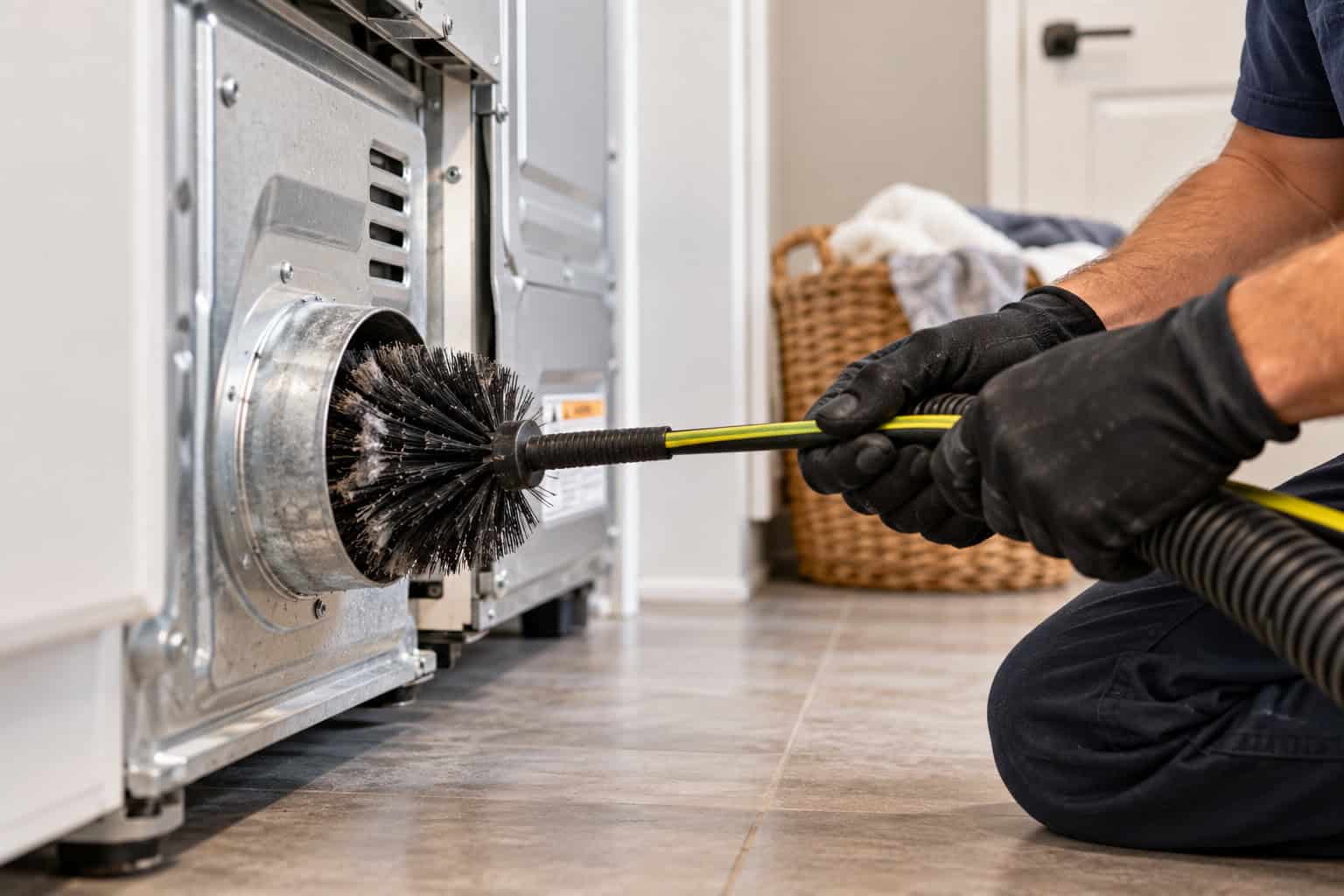
Some simple dryer-maintenance tasks can certainly be performed by homeowners.
Cleaning the lint filter, checking the area behind the dryer, and visually checking the exterior vent are basic maintenance steps.
There are also consumer dryer-vent cleaning tools available.
However, not every exhaust system is equally accessible.
Long ducts, multiple bends, second-story outlets, roof terminations, unusual vent configurations, or significant buildup can make the job more complicated.
Homeowners should also avoid damaging the ductwork or accidentally disconnecting vent sections.
If you are uncertain about the configuration, cannot reach the full exhaust path, or continue experiencing poor airflow after basic maintenance, professional service may be appropriate.
What Should Professional Dryer Vent Cleaning Accomplish?
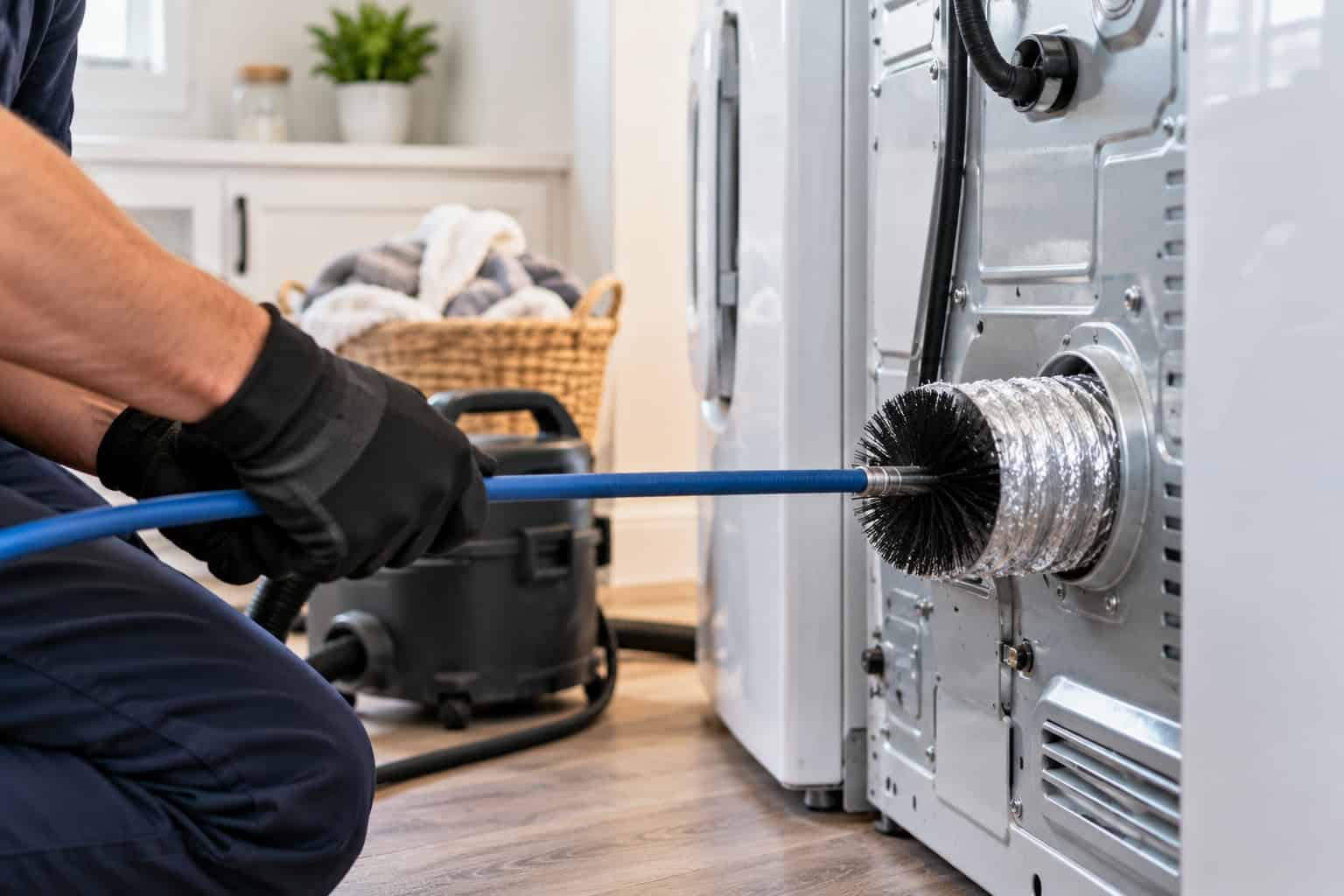
The fundamental purpose of dryer vent cleaning is straightforward: remove accumulated lint and removable debris from the exhaust path so the vent can remain clear.
The exact cleaning procedure can vary depending on the vent configuration and the service provider.
That is why it is better not to assume that every professional dryer vent cleaning company follows one identical five-step process or uses exactly the same equipment.
At Orion Cleaning Solutions, the service should be evaluated based on the actual dryer vent system rather than treating every home as identical.
The vent’s accessibility, length, configuration, and amount of buildup can all affect the work required.
If you are considering service, learn more about Orion’s dryer vent cleaning in Cleveland and surrounding communities.
How Long Does Dryer Vent Cleaning Take?
There is no exact cleaning time that applies to every dryer vent.
The current condition and configuration of the exhaust system can affect how much work is required.
A relatively straightforward vent may be easier to service than one that:
- Has a long exhaust path
- Contains several bends
- Has substantial buildup
- Is difficult to access
- Terminates in a challenging location
- Has another issue requiring additional evaluation
For that reason, it is better not to promise that every dryer vent will be cleaned within a specific 30- or 60-minute window.
The priority should be properly addressing the vent system rather than completing every job within an arbitrary amount of time.
Can a Dirty Dryer Vent Cause a Fire?
Lint and restricted dryer exhaust systems are recognized fire-safety concerns.
The CPSC warns that lint buildup in a dryer or exhaust duct can block airflow, contribute to excessive heat buildup, and lead to fire in some dryers.
In a 2023 safety release, the CPSC estimated an annual average of about 6,400 clothes dryer fires and specifically recommended cleaning lint from the vent pipe at least once each year.
That does not mean every dirty dryer vent is about to catch fire.
It does mean dryer vent maintenance is a legitimate fire-prevention issue rather than simply a matter of drying performance.
Homeowners should follow their dryer manufacturer’s instructions and appropriate fire-safety guidance.
The fire-safety aspect is another reason homeowners should take how often should dryer vents be cleaned seriously rather than waiting indefinitely between cleanings.
Can a Clogged Dryer Vent Increase Drying Time?
Restricted airflow is one possible cause of longer drying cycles.
The CPSC specifically identifies clothing remaining damp after a typical cycle or taking longer than normal to dry as a possible indication that the lint screen or exhaust duct is blocked.
However, not every slow-drying problem is caused by the vent.
The appliance itself can have other mechanical or electrical issues.
If vent maintenance does not resolve the problem, the dryer may need to be evaluated by an appropriate appliance professional.
How Often Should Dryer Vents Be Cleaned in a Large Household?
There is no single interval that applies to every large household.
Once per year remains a useful baseline because it aligns with federal safety recommendations, but frequent dryer use means homeowners should watch the system more closely.
If drying times increase, airflow weakens, or other warning signs appear, the vent may need attention sooner.
The best answer to how often should dryer vents be cleaned is therefore not simply “every 12 months no matter what.”
It is:
Use annual cleaning as a strong baseline, maintain the lint filter with every load, and respond sooner if the system shows signs of restricted airflow or buildup.
How Often Should Dryer Vents Be Cleaned in Northeast Ohio?
The basic safety guidance does not change simply because a home is located in Northeast Ohio.
However, local homes can have very different layouts and vent configurations.
Dryers may be located:
- In basements
- In first-floor laundry rooms
- On upper floors
- Near garages
- In interior utility rooms
Those locations can result in very different exhaust paths.
A short vent through an exterior wall is not the same as a longer run that travels through another portion of the building.
For homeowners in Cleveland and surrounding communities, the most useful approach is to know the vent configuration, maintain the lint screen consistently, and follow an appropriate cleaning schedule based on use and condition.
When Northeast Ohio homeowners ask how often they should clean dryer vents, the annual baseline remains useful, but each home’s dryer use and exhaust configuration should still be considered.
Orion Cleaning Solutions provides dryer vent cleaning for homeowners in Cleveland and surrounding Northeast Ohio communities, including Beachwood, Solon, Mayfield Heights, Chagrin Falls, Pepper Pike, Mentor, and Willoughby.
Frequently Asked Questions About Dryer Vent Cleaning
How often should I get my dryer vents cleaned?
For many homes, approximately once per year is a useful baseline. The U.S. Fire Administration recommends cleaning dryer vent ductwork every year, while the CPSC recommends removing lint from the vent pipe at least annually. Heavy use or warning signs of restricted airflow may justify earlier attention.
What is the biggest sign that a dryer vent may need cleaning?
Longer drying times are one of the most recognizable warning signs. The CPSC notes that clothes remaining damp after a normal cycle or taking longer than usual to dry may indicate a blocked lint screen or exhaust duct.
Should I clean the lint trap every time I use the dryer?
Yes. Federal fire-safety guidance recommends cleaning the lint filter before or after each load or every time the dryer is used.
Does a dryer vent need cleaning if the dryer still works?
Possibly. A dryer does not have to stop working completely before the vent needs maintenance. If it has been more than a year since the vent was cleaned, annual maintenance is worth considering even if there are no dramatic symptoms.
Should dryer vents be cleaned every six months?
Not automatically. Some high-use or more complicated systems may require more frequent attention, but there is not a universal six-month rule for every home. Annual cleaning is a better general baseline, with earlier service based on usage, vent configuration, and warning signs.
Can dryer vent cleaning fix a broken dryer?
No. Dryer vent cleaning addresses the exhaust path. It does not repair mechanical, electrical, heating, or control problems within the appliance.
Is a burning smell normal when using a dryer?
A new or unusual burning smell should not be ignored. Stop using the appliance if you believe it may be unsafe and have the situation evaluated appropriately. Do not assume vent cleaning alone will correct every dryer-related problem.
Final Thoughts: How Often Should Dryer Vents Be Cleaned?
So, how often should dryer vents be cleaned?
For most homeowners, about once per year is a strong general starting point, supported by recommendations from the U.S. Fire Administration and Consumer Product Safety Commission.
But the calendar is only part of the answer.
Dryer usage, vent length, duct configuration, drying performance, exterior airflow, and visible lint buildup can all indicate that a vent deserves attention sooner.
When deciding how often dryer vents should be cleaned, homeowners should use annual cleaning as a baseline while also paying attention to what the dryer and exhaust system are actually doing.
The most practical maintenance approach is to:
- Clean the lint screen every load.
- Monitor drying times.
- Check that the exterior vent opens and exhausts air.
- Watch for unusual heat or other changes.
- Keep the vent system from becoming damaged or restricted.
- Have the dryer vent cleaned approximately annually or sooner when conditions indicate a problem.
Keeping the dryer exhaust path clear is one simple part of maintaining a home and using the appliance more safely.
If your dryer vent has not been cleaned recently or you’re noticing possible signs of restricted airflow, contact Orion Cleaning Solutions for a free estimate.