
Table of Contents
Tile floors are a popular choice for kitchens, bathrooms, mudrooms, entryways, and other high-traffic areas because they are durable, attractive, and relatively easy to maintain. However, even with regular sweeping and mopping, many homeowners eventually notice that their floors no longer look as clean as they once did. In many cases, the tile itself is not the problem—the grout lines are.
Grout is much more porous than most tile surfaces. Over time, dirt, spills, grease, cleaning-product residue, and everyday foot traffic can become embedded in the grout. The result is grout that gradually becomes darker, uneven, or discolored even when the surrounding tile is regularly cleaned.
For homeowners in Cleveland and surrounding communities, deciding between DIY methods and professional tile and grout cleaning often comes down to the condition of the floor, how much buildup is present, and the results they are trying to achieve.
DIY cleaning can be useful for routine maintenance and minor surface soil. However, heavily soiled or deeply discolored grout may require professional equipment and cleaning methods to remove buildup that ordinary mopping and household products leave behind.
Understanding the differences between the two approaches can help you determine the best option for your floors.
Why Tile and Grout Get Dirty Faster Than You Think
Most tile surfaces are relatively resistant to moisture and staining, particularly when properly maintained. Grout is different.
Traditional cement-based grout contains tiny pores that can absorb soil and moisture. Every time someone walks across the floor, small particles of dirt can be pushed into the grout lines. In kitchens, cooking residue and grease may contribute to buildup. Bathrooms can accumulate soap residue, moisture, and other contaminants.
Regular mopping removes a large amount of surface dirt, but it can also move dirty water across the floor. As the mop passes over recessed grout lines, some of that soil can settle into the grout rather than being completely removed.
Over time, grout may change from its original color to gray, brown, yellow, or nearly black in heavily traveled areas.
Homes with children, pets, frequent visitors, or busy entryways may experience faster buildup. Northeast Ohio weather can also contribute. Rain, mud, snow, and winter residue tracked into the home can increase the amount of soil reaching tile floors.
This is why a floor may be mopped regularly yet still gradually appear darker.
Why Grout Is More Difficult to Clean Than Tile
The difference between the tile surface and the grout lines is one of the biggest reasons homeowners struggle with floor cleaning.
Tile is generally smoother and easier to wipe clean. Grout lines are recessed and textured, allowing soil to collect below the surface of the tile.
Once dirt becomes embedded in porous grout, simply wiping across the surface may not remove it.
Several factors can make grout particularly difficult to clean:
- Porous material that absorbs soil and moisture
- Recessed grout lines that collect dirty water
- Grease and food residue in kitchens
- Soap residue in bathrooms
- Heavy foot traffic
- Pet-related soil
- Cleaning-product buildup
- Dirt tracked inside from outdoors
The longer this buildup remains, the more difficult it may become to remove with ordinary household cleaning.
This is one reason homeowners sometimes spend hours scrubbing only to find that the grout still looks uneven when the floor dries.
For heavily soiled floors, professional tile and grout cleaning can remove buildup that routine mopping and hand scrubbing may leave behind.
Common DIY Tile and Grout Cleaning Methods
Many homeowners try DIY cleaning before considering professional service. That is completely reasonable, especially when the floor only has light surface soil.
Several common methods can help with routine maintenance, but each also has limitations.
Scrubbing With Household Cleaners
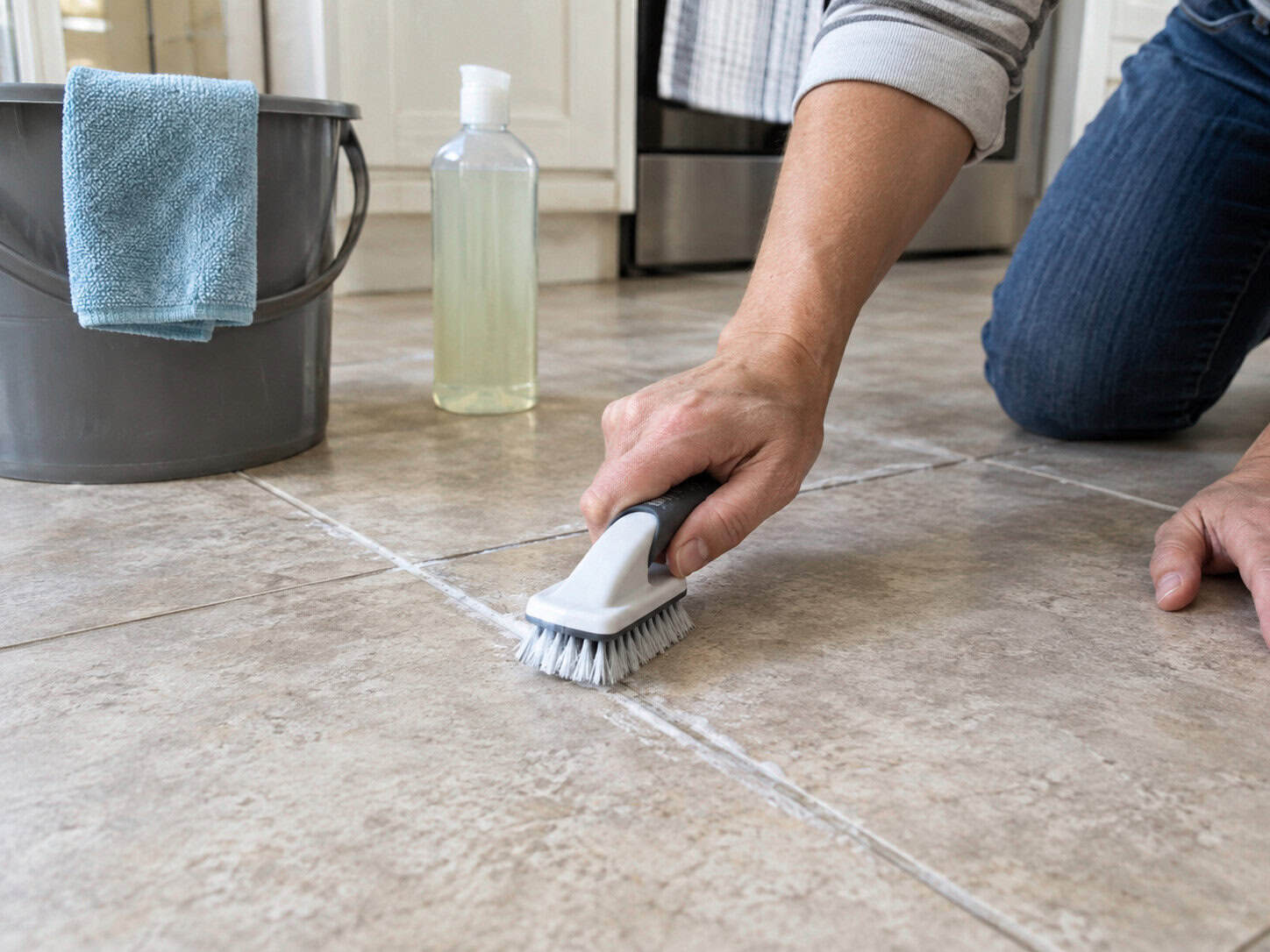
One of the most common approaches is applying a household cleaner and scrubbing the grout with a brush.
For light discoloration, this can make a noticeable difference.
The difficulty begins when large floor areas need to be cleaned. Scrubbing grout by hand can be physically demanding and time-consuming. It can also be difficult to produce consistent results across an entire kitchen, hallway, or bathroom.
Aggressive scrubbing may also wear grout over time, particularly if very stiff brushes or abrasive products are repeatedly used.
The goal should be to remove soil without unnecessarily damaging the grout itself.
Baking Soda, Vinegar, and Other Homemade Solutions
Homemade cleaning solutions are widely discussed online. Baking soda is sometimes used as a mild abrasive, while vinegar is frequently recommended for household cleaning.
However, not every cleaner is appropriate for every type of tile, grout, stone, or sealer.
Acidic cleaners can react with some mineral-based materials, and repeated use of harsh products can potentially affect grout or protective sealers.
Before using any homemade product, homeowners should confirm that it is appropriate for the specific flooring material.
When in doubt, a pH-neutral cleaner designed for tile and grout is generally a safer choice for routine maintenance.
Steam Cleaning Rentals
Some homeowners rent consumer-grade steam machines hoping to remove deeper buildup.
These machines may help loosen some surface soil, but equipment varies considerably in temperature, pressure, water recovery, and overall cleaning ability.
Another challenge is extracting the loosened dirt.
Loosening soil is only part of the cleaning process. The dirty solution also needs to be removed from the surface rather than redistributed across the floor.
Rental machines may be useful in some situations, but heavily soiled grout often requires more thorough agitation and extraction.
Grout Pens and Whitening Products
Grout pens can make grout appear brighter because they cover discoloration with a new layer of color.
That can provide a quick cosmetic improvement, but it is different from actually cleaning embedded soil from the grout.
Applying a whitening product over dirty grout may simply conceal the problem temporarily.
If grout is severely stained but otherwise structurally sound, professional cleaning followed by grout color sealing may provide a more complete solution. Color sealing can help create a more uniform appearance while also adding protection to the grout surface.
What Professional Tile and Grout Cleaning Involves
Professional tile and grout cleaning typically involves more than simply running a machine across the floor.
The exact process depends on the flooring material and condition, but professional cleaning may include several stages.
Inspecting the Floor
Before cleaning begins, the floor should be evaluated.
Technicians may look for:
- Heavily soiled areas
- Existing grout damage
- Loose or cracked grout
- Stains
- Previous sealers or coatings
- Different types of tile or stone
- Areas requiring additional attention
Identifying these conditions before cleaning helps determine the appropriate process.
Applying the Cleaning Solution
A cleaning solution designed for the flooring is applied to help loosen soil, grease, and residue.
Allowing the product sufficient dwell time can help break down buildup that has accumulated in the grout lines.
The correct chemistry is important because different flooring materials respond differently to cleaning products.
Agitating the Grout
Mechanical or manual agitation may be used to loosen embedded soil.
Grout lines often need more attention than the tile surface because dirt can become trapped within their textured structure.
Agitation helps separate that soil from the grout so it can be removed during extraction.
Rinsing and Extracting the Soil
Professional equipment can rinse the flooring while extracting loosened dirt and cleaning solution.
This is one of the major differences between professional cleaning and ordinary mopping.
Instead of repeatedly moving dirty water across the floor, extraction removes much of that contaminated solution from the surface.
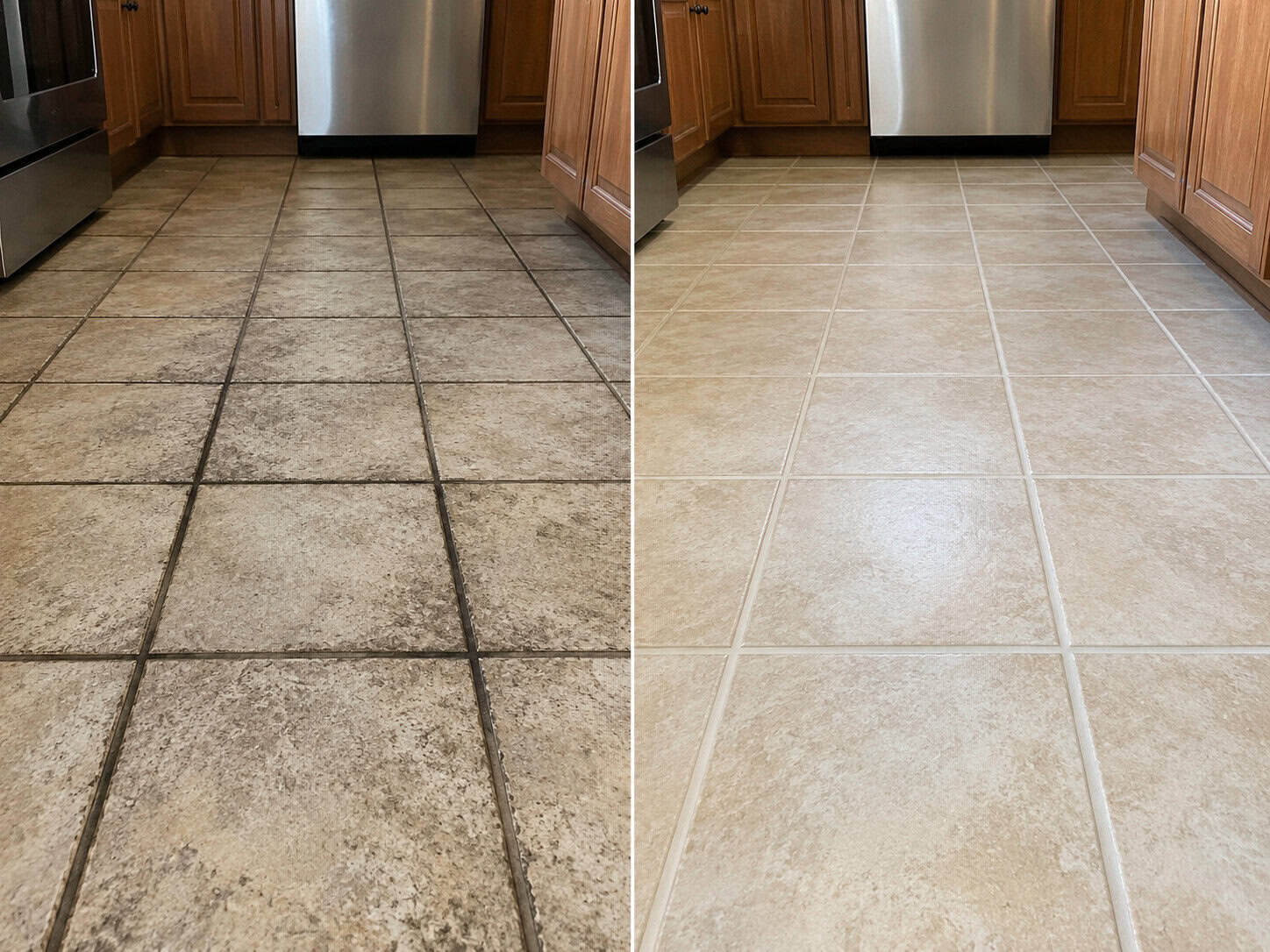
The result can be a much more noticeable improvement, particularly when grout has accumulated years of soil.
Final Inspection
After cleaning, technicians can examine the floor for areas that may require additional treatment.
It is also an opportunity to identify grout that remains permanently stained or areas where the grout itself has deteriorated.
Not every discoloration can always be removed through cleaning alone, which is why evaluating the condition of the grout is important.
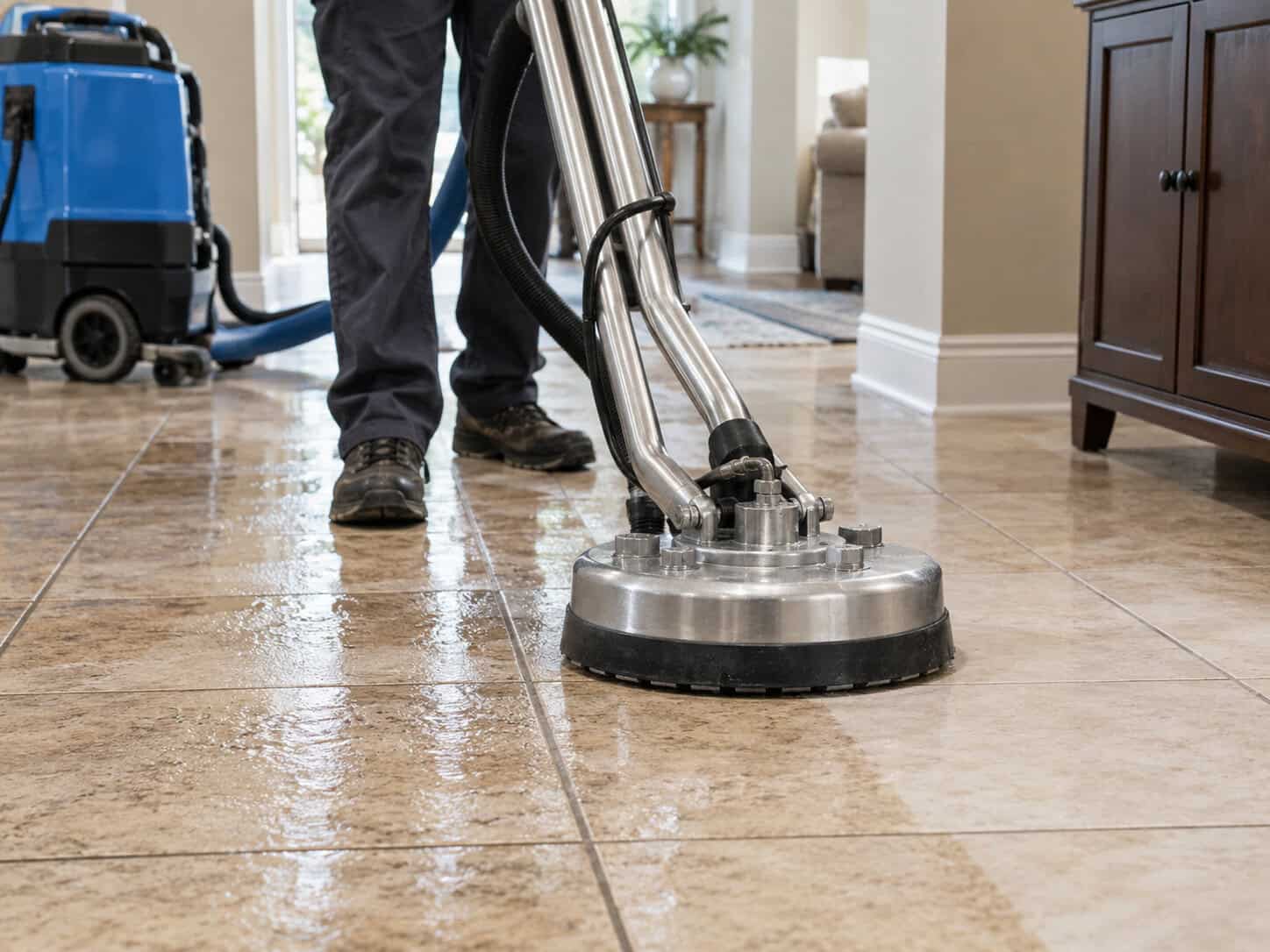
What Professional Tile and Grout Cleaning Can Do That DIY Cannot
The biggest advantage of professional tile and grout cleaning is the combination of specialized cleaning solutions, agitation, professional equipment, and extraction.
A homeowner with a brush may successfully clean a small section of grout, but reproducing that result consistently across hundreds of square feet can be difficult.
Professional cleaning can be particularly beneficial when:
- Grout remains dark after mopping
- Traffic lanes are clearly visible
- Kitchen grout has accumulated grease
- Large areas need to be cleaned
- The grout color looks uneven
- DIY scrubbing produces inconsistent results
- The floor has not been professionally cleaned in several years
Professional equipment also allows technicians to address the tile surface and grout simultaneously rather than cleaning each grout line individually by hand.
For larger floors, this can make a significant difference in both efficiency and consistency.
For embedded soil and heavily discolored grout, consider professional tile and grout cleaning from Orion Cleaning Solutions.
Tile and Grout Cleaning in Kitchens
Kitchen tile experiences a combination of foot traffic, food spills, cooking residue, and grease.
Even when spills are cleaned quickly, small amounts of residue can accumulate over time.
Areas around the stove, sink, refrigerator, kitchen island, and entrances often show discoloration first because these locations receive the most use.
Mopping can maintain the floor, but it may not completely remove buildup that has worked into the grout.
Professional cleaning can help remove accumulated soil from both the tile surface and grout lines, giving the entire kitchen floor a more uniform appearance.
Tile and Grout Cleaning in Bathrooms
Bathrooms create a different set of challenges.
Moisture, soap residue, personal-care products, and poor ventilation can contribute to buildup on tile and grout.
Bathroom floors, shower areas, and other tiled surfaces may also remain damp longer than flooring in other parts of the home.
Regular ventilation and drying are important for reducing moisture.
If mold or mildew repeatedly develops, the underlying moisture source should also be addressed. Cleaning alone cannot correct an ongoing ventilation, leak, or humidity problem.
The Environmental Protection Agency provides additional information about controlling moisture and mold inside homes.
Can DIY Cleaning Damage Grout?
DIY cleaning is not automatically harmful. Many homeowners successfully maintain tile floors using appropriate cleaners and gentle cleaning methods.
Problems usually occur when aggressive techniques are used repeatedly.
Potential issues include:
- Using extremely abrasive brushes
- Applying cleaners that are inappropriate for the flooring
- Repeatedly using strong acidic products
- Using excessive amounts of cleaner
- Allowing cleaning residue to remain on the floor
- Scrubbing deteriorated grout too aggressively
More cleaning power is not always better.
A cleaner that works well on one surface may not be appropriate for natural stone, sealed grout, or another flooring material.
Always follow the flooring manufacturer’s recommendations whenever possible.
Professional Tile and Grout Cleaning vs DIY: Time, Effort, and Results
DIY cleaning generally costs less upfront because homeowners provide their own labor.
For a small bathroom or a few lightly soiled grout lines, that may make sense.
The calculation changes with larger areas.
Imagine scrubbing every grout line across a kitchen, hallway, bathroom, and entryway. The project can quickly take several hours or even require multiple cleaning sessions.
Professional cleaning reduces much of that manual labor while using equipment designed to treat larger areas efficiently.
The right choice depends on the floor.
DIY may be practical when:
- The floor is maintained regularly
- Grout has only minor discoloration
- The area is relatively small
- There are no deep or persistent stains
- The homeowner is comfortable doing the work
Professional cleaning may be more appropriate when:
- Large areas are involved
- Grout is heavily discolored
- Years of buildup are present
- DIY cleaning has already been attempted
- Consistent results are important
- The property is being prepared for sale
- The homeowner wants to avoid hours of scrubbing
The question is not necessarily whether DIY cleaning works. It is whether DIY cleaning can produce the desired result for the particular condition of the floor.
When DIY Cleaning Might Be Enough
Not every tile floor requires professional cleaning.
Regular maintenance can keep lightly used floors looking good for long periods of time.
DIY cleaning is often sufficient when soil remains near the surface and the grout still looks relatively close to its original color.
Homeowners can help maintain tile and grout by vacuuming or sweeping first, using an appropriate floor cleaner, changing dirty cleaning water frequently, and addressing spills quickly.
The earlier soil is removed, the less opportunity it has to become embedded.
When Should You Consider Professional Tile and Grout Cleaning?
There is no single rule that applies to every home, but several signs suggest that routine cleaning may no longer be enough.
Consider professional tile and grout cleaning when:
- Grout remains dark after regular cleaning
- Grout lines are noticeably different colors
- Floors look dull even after mopping
- Heavy traffic areas remain visibly dirty
- Kitchen grout has accumulated grease or residue
- DIY scrubbing has produced limited results
- Large areas require cleaning
- You are preparing the home for sale
- You want the floor professionally cleaned before sealing or color sealing
A professional evaluation can also help determine whether the problem is actually dirt or whether the grout has become permanently stained or damaged.
What If Cleaning Does Not Restore the Grout Color?
One important point is that grout cleaning and grout restoration are not always the same thing.
Sometimes grout is dirty.
Other times, grout has become permanently discolored.
If professional cleaning removes the embedded soil but the grout still has inconsistent coloring, additional options may be available.
One option is grout color sealing.
Color sealing applies a specialized coating to cleaned grout lines, creating a more uniform appearance while helping protect the grout from future staining.
This can be particularly useful when older grout remains structurally sound but no longer has a consistent color.
However, damaged or crumbling grout may require repair rather than cleaning or sealing.
Should Grout Be Sealed After Cleaning?
Grout sealing can help reduce the amount of soil and moisture that penetrates porous grout.
Whether sealing is appropriate depends on the grout type, condition, flooring material, and existing treatments.
Traditional penetrating sealers are designed to reduce absorption while allowing the original appearance of the grout to remain visible.
Color sealers provide protection while also changing or refreshing the visible grout color.
Neither option eliminates the need for regular cleaning, but properly maintained sealed grout may be easier to keep clean.
Cleaning should generally be completed before applying a new sealer so dirt is not trapped beneath the protective coating.
How Often Should Tile and Grout Be Professionally Cleaned?
There is no universal schedule for every home.
Cleaning frequency depends on factors such as:
- Number of occupants
- Pets
- Children
- Foot traffic
- Location of the tile
- Kitchen grease exposure
- Bathroom moisture
- How frequently the floor is maintained
- Whether the grout is sealed
- Amount of dirt tracked indoors
For some homes, professional cleaning every year may make sense. Others may go considerably longer.
Rather than relying only on a calendar, homeowners should pay attention to the appearance of the grout.
When regular maintenance stops producing acceptable results, it may be time for deeper cleaning.
Maintaining Tile and Grout Between Professional Cleanings
Professional cleaning provides the best long-term value when homeowners continue maintaining the floor afterward.
Regular maintenance between professional tile and grout cleaning appointments can help prevent dirt from becoming deeply embedded in the grout.
A few simple habits can help reduce buildup.
Vacuum or Sweep Regularly
Dry soil acts like an abrasive when walked across flooring.
Removing loose dirt before mopping reduces the amount that becomes mixed into cleaning water and pushed into grout lines.
Use the Right Cleaner
Choose cleaners intended for the specific tile and grout in your home.
A pH-neutral product is often appropriate for routine maintenance, although homeowners should always follow manufacturer recommendations.
Using excessive detergent can leave residue behind, which may actually attract additional soil.
Change Dirty Mop Water
Cleaning an entire large floor with the same bucket of increasingly dirty water can redistribute soil.
Changing the water during cleaning helps prevent that.
Clean Spills Quickly
Food, drinks, oils, and other substances are easier to remove before they have time to penetrate porous grout.
Use Entry Mats
Entry mats reduce the amount of outdoor soil, mud, and winter residue tracked onto tile flooring.
This is especially helpful during Northeast Ohio winters.
Control Bathroom Moisture
Use ventilation fans when available and allow wet surfaces to dry.
Reducing excess moisture helps create a less favorable environment for mold and mildew.
Why Local Experience Matters
Homes throughout Greater Cleveland encounter seasonal conditions that can affect flooring.
Rain and mud increase tracked-in soil during warmer months, while snow, slush, and winter residue can be carried inside during colder weather.
Entryways, mudrooms, kitchens, and connecting hallways often receive the most traffic.
A professional cleaning company familiar with local homes can evaluate these conditions and recommend an appropriate cleaning process based on the floor rather than applying the exact same method to every property.
Orion Cleaning Solutions serves homeowners throughout Cleveland and surrounding communities, including areas such as Beachwood, Chagrin Falls, Chesterland, Gates Mills, Highland Heights, Mayfield Heights, Mayfield Village, Mentor, Pepper Pike, Solon, Willoughby, and other nearby communities.
Why Homeowners Choose Orion Cleaning Solutions
Orion Cleaning Solutions has provided professional cleaning services in the Cleveland area since 2007.
Our tile and grout cleaning service is designed to remove soil and buildup that ordinary maintenance can leave behind while improving the overall appearance of tiled floors.
Because many homes contain several different flooring and surface types, Orion also provides additional services including:
- Carpet cleaning
- Upholstery cleaning
- Area rug cleaning
- Grout color sealing
- Move-in and move-out cleaning
- Mattress cleaning
- Dryer vent cleaning
- Commercial cleaning
This makes it possible to address multiple cleaning needs during the same overall project rather than coordinating several different companies.
To explore Orion’s available services, visit our complete cleaning services page.
Making the Right Choice for Your Home
DIY cleaning remains an important part of maintaining tile floors.
Routine sweeping, mopping, spill removal, and occasional grout scrubbing can prevent many problems from becoming severe.
However, there is a point where additional scrubbing provides diminishing returns.
When grout remains dark, traffic areas look noticeably different, or years of soil have accumulated, professional tile and grout cleaning may provide a deeper and more consistent result.
The best approach is not necessarily choosing between DIY and professional cleaning permanently.
Instead, the two can work together.
Regular homeowner maintenance helps control everyday soil, while periodic professional cleaning addresses deeper buildup that becomes difficult to remove through ordinary methods.
For homeowners dealing with stubborn discoloration or years of buildup, professional tile and grout cleaning can be the most efficient way to restore a cleaner, more consistent appearance.
If your tile floors no longer look clean even after regular mopping and scrubbing, Orion Cleaning Solutions can evaluate the condition of your tile and grout and recommend the appropriate cleaning approach.
Request a free estimate to learn more about professional tile and grout cleaning, or explore the communities included in our cleaning service area.