
Table of Contents
If you’re interested in professional commercial carpet cleaning in spring and fall, click here.
Commercial carpets deal with much more than everyday foot traffic. In Northeast Ohio, they also face seasonal changes that bring road salt, slush, mud, moisture, pollen, dust, and outdoor debris into offices and other commercial buildings.
For Cleveland-area businesses, commercial carpet cleaning in spring and fall can help address this seasonal buildup before it becomes more noticeable.
That is why commercial carpet cleaning in spring and fall can be a practical part of a year-round maintenance plan.
Spring gives businesses an opportunity to remove residue left behind during winter. Fall provides another useful reset before snow, road salt, and wet weather return. For some commercial properties, scheduling professional cleaning around these seasonal transitions can help keep carpets looking cleaner and make routine maintenance easier throughout the year.
That does not mean every commercial carpet should automatically be cleaned twice a year. Cleaning frequency should depend on the amount of foot traffic, the type of business, carpet condition, entryway protection, routine vacuuming, spills, and other building-specific factors.
However, for many offices, medical facilities, schools, churches, apartment common areas, retail spaces, and professional buildings, spring and fall can be convenient times to evaluate carpet condition and schedule deeper cleaning when needed.
Here are eight important benefits of commercial carpet cleaning in spring and fall.
1. Spring Cleaning Helps Remove Winter Salt, Slush, and Tracked-In Soil
Winter can be especially difficult on commercial carpeting in Cleveland and surrounding communities.
Employees, customers, tenants, patients, and visitors may repeatedly walk through snow, slush, road salt, and wet parking lots before entering a building. Entry mats capture some of that material, but they cannot stop everything.
Over the course of winter, soil can gradually move beyond the entrance and into:
- Reception areas
- Main hallways
- Elevator areas
- Waiting rooms
- Stair landings
- Office corridors
- Common areas
- Breakrooms
Road salt residue can be particularly noticeable on darker carpeting. Once moisture dries, light-colored residue may remain on the carpet surface or become worked deeper into traffic areas.
Regular vacuuming is essential, but vacuuming primarily addresses loose dry soil. It may not fully remove residue that has bonded to carpet fibers or material that has been pushed deeper through repeated foot traffic.
This is one of the strongest reasons to consider commercial carpet cleaning in spring and fall.
A spring cleaning provides an opportunity to address the accumulation left behind after months of winter weather.
Professional cleaning may include pretreatment of heavily used areas, additional attention to spots and traffic lanes, and extraction designed to remove loosened soil and residue from the carpet.
Instead of carrying winter buildup into summer, businesses can begin the warmer season with a cleaner starting point.
2. Spring Provides a Natural Reset After Months of Indoor Traffic
Winter weather often means people spend more time indoors.
Commercial buildings continue receiving daily traffic even when the outdoor conditions are poor, and floors may experience repeated cycles of moisture, drying, tracked-in debris, and routine maintenance.
By spring, carpeting near entrances and major walkways may look noticeably different from less-used areas.
Common signs include:
- Darkened traffic lanes
- Dull carpet appearance
- Visible spots
- Salt residue
- Soil near doorways
- Mat outlines
- Uneven appearance between high- and low-traffic areas
This is one reason commercial carpet cleaning in spring and fall can be useful for evaluating and addressing seasonal carpet buildup.
Commercial carpet cleaning in spring and fall works well as part of a seasonal inspection routine because businesses can identify problem areas before they become easier to overlook.
A carpet does not necessarily need to look extremely dirty before professional cleaning becomes appropriate.
In fact, waiting until large traffic patterns are obvious may mean a significant amount of soil has already accumulated.
A spring cleaning can help restore a more consistent appearance throughout the facility and provide a cleaner foundation for regular vacuuming and spot maintenance during the warmer months.
For businesses that welcome customers, patients, clients, or visitors, this reset can also improve the appearance of reception areas and other spaces that contribute to a first impression.
3. Fall Cleaning Removes Soil Accumulated During Spring and Summer
Winter is not the only season that affects commercial carpet.
During spring and summer, people can track in:
- Soil
- Dust
- Pollen
- Grass
- Landscaping debris
- Parking lot dirt
- Fine outdoor particles
- Mud after rain
Dry summer conditions can also create significant amounts of fine dust around parking lots, sidewalks, construction areas, and building entrances.
Some material remains near the entrance, while smaller particles can be carried farther into the building.
A busy commercial property may therefore accumulate months of soil before fall arrives.
Commercial carpet cleaning in spring and fall provides a second seasonal reset before the weather changes again.
Commercial carpet cleaning in spring and fall can remove warmer-season buildup before the building enters winter.
This can be especially useful in properties with significant foot traffic.
Examples include:
- Medical offices
- Schools and training centers
- Retail environments
- Multi-tenant office buildings
- Apartment common areas
- Churches and worship facilities
- Professional offices
- Hospitality spaces
The exact cleaning schedule will vary, but fall is a convenient point to assess how the carpet handled the warmer months.
4. Fall Cleaning Helps Prepare Carpets for Winter
There is another reason fall can be useful: it comes immediately before one of the most difficult periods for commercial flooring in Northeast Ohio.
When winter arrives, snow, salt, slush, and moisture can begin entering the building again.
Starting that season with carpet that already contains months of accumulated soil means new contaminants are being added on top of existing buildup.
Professional cleaning before winter helps start the season with a cleaner carpet.
It also gives property managers an opportunity to identify areas that may require extra protection.
For example, fall is a good time to evaluate:
- Entrance mats
- Walk-off areas
- Main traffic paths
- Carpet near exterior doors
- Carpet around elevators
- Areas near parking lot entrances
- Secondary building entrances
If certain zones consistently become heavily soiled during winter, businesses can adjust vacuuming frequency or mat placement before the first major snowfall.
Commercial carpet cleaning in spring and fall works best when it is part of a broader maintenance strategy rather than an isolated cleaning event.
Professional cleaning removes accumulated soil, while entry mats, routine vacuuming, and quick spot treatment help slow the next round of buildup.
5. Seasonal Cleaning Helps Address High-Traffic Areas Before They Become More Noticeable
Not every section of commercial carpet receives the same amount of use.
A private office may receive limited foot traffic while a hallway outside that office experiences hundreds of passes during the same period.
That creates predictable high-traffic areas.
Common examples include:
- Main entrances
- Reception desks
- Hallways
- Elevator entrances
- Waiting rooms
- Conference room entrances
- Breakroom entrances
- Areas around copy machines
- Paths between departments
Over time, these areas may begin to look darker or flatter than surrounding carpet.
Some of the difference may be removable soil. Other changes may eventually involve physical wear to the fibers.
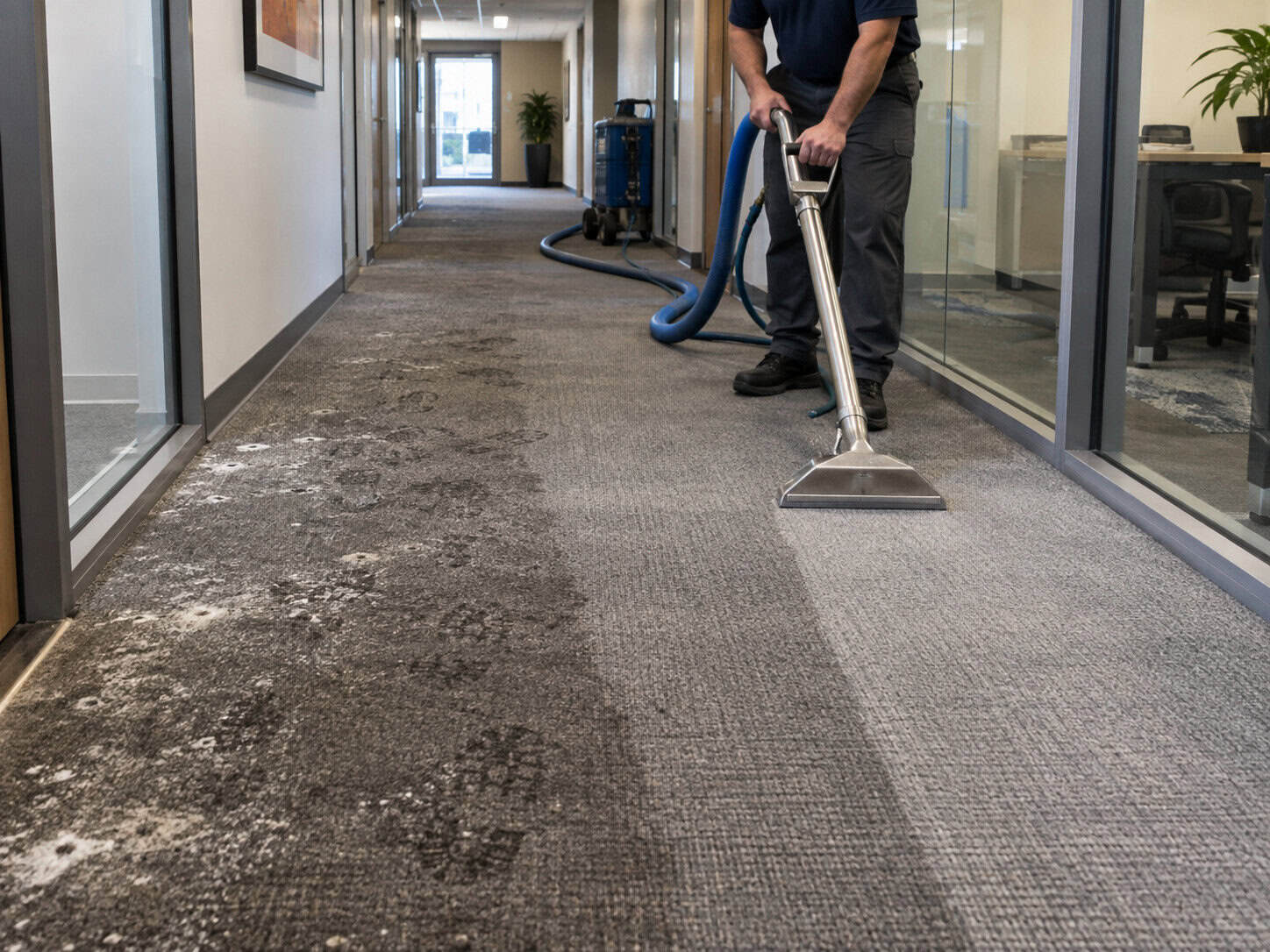
Professional cleaning cannot repair permanently worn carpet, but removing accumulated soil before it becomes severe can help maintain a more consistent appearance.
Another benefit of commercial carpet cleaning in spring and fall is the opportunity to address high-traffic areas before soil becomes increasingly noticeable.
Instead of waiting for traffic lanes to become extremely obvious, businesses can use seasonal cleaning as a checkpoint.
During a professional cleaning, heavily used areas can receive additional attention through appropriate pretreatment, agitation when necessary, spot treatment, and extraction.
Facilities with exceptionally heavy traffic may need cleaning more frequently than twice per year. Seasonal cleaning should not replace a maintenance schedule based on actual carpet condition.
However, spring and fall are useful times to examine whether high-traffic areas are beginning to look different from the rest of the facility.
6. Professional Extraction Goes Beyond Routine Vacuuming
Routine vacuuming is one of the most important parts of commercial carpet maintenance.
Frequent vacuuming removes loose particles before they become worked deeper into the carpet.
Commercial carpet cleaning in spring and fall adds periodic deeper cleaning to the routine vacuuming businesses perform throughout the year.
Vacuuming and professional carpet cleaning perform different jobs.
Vacuuming is designed mainly for ongoing dry-soil removal.
Professional cleaning can address material that routine maintenance may leave behind, including:
- Embedded soil
- Some traffic-lane buildup
- Selected stains
- Residue
- Tracked-in contaminants
- Certain odor sources
The exact cleaning process should depend on the carpet construction, soil level, condition, and manufacturer recommendations.
A typical professional process may include several stages.
Carpet Inspection
Before cleaning begins, the carpet can be evaluated for traffic patterns, spots, stains, wear, and areas requiring additional attention.
This also helps identify problems that cleaning may not correct.
Permanent fiber damage, fading, worn carpet, or some types of staining may remain even after soil is removed.
Pretreatment
Appropriate cleaning products may be applied to help loosen accumulated soil and residue.
Traffic areas often require more attention than lightly used sections.
Agitation When Needed
Some carpets or heavily soiled areas may benefit from agitation to help separate soil from the fibers before extraction.
Professional Extraction
Extraction equipment is used to rinse the carpet and remove loosened soil, cleaning solution, and moisture.
This is an important difference between surface cleaning and deeper professional carpet maintenance.
Commercial carpet cleaning in spring and fall gives facilities an opportunity to perform this deeper process periodically while continuing routine vacuuming throughout the rest of the year.
The Carpet and Rug Institute’s commercial carpet standards emphasize routine maintenance, high-traffic-area care, and periodic deep cleaning as part of a proper commercial carpet maintenance program.
7. Spring and Fall Can Fit Naturally Into a Commercial Maintenance Schedule
One of the advantages of seasonal carpet cleaning is that it can be easy to remember.
Property managers already organize many building-maintenance tasks around seasonal transitions.
Spring may involve:
- Exterior cleanup
- Window cleaning
- HVAC maintenance
- Landscaping
- Floor maintenance
Fall may involve:
- Winter preparation
- Heating-system checks
- Entryway preparation
- Exterior maintenance
- Seasonal deep cleaning
Carpet cleaning can fit naturally into those schedules.
Scheduling commercial carpet cleaning in spring and fall also gives property managers two easy maintenance dates to plan around each year.
For moderate-traffic facilities, commercial carpet cleaning in spring and fall may provide a useful starting point for planning.
However, it should not be treated as a universal rule.
Different commercial properties may require very different schedules.
The EPA does not recommend one universal carpet-cleaning frequency and instead advises following carpet-manufacturer recommendations and recognized industry standards.
Lower-Traffic Properties
Small professional offices with limited visitors may need professional carpet cleaning less frequently.
If employees work primarily in private offices and the building has strong entrance matting and regular vacuuming, the carpet may remain presentable for longer periods.
Moderate-Traffic Properties
Medical offices, corporate offices, financial institutions, and similar facilities may benefit from more regular professional cleaning.
Spring and fall may work particularly well as two scheduled maintenance points.
High-Traffic Properties
Schools, busy common areas, retail-adjacent offices, large facilities, apartment corridors, and buildings with heavy public traffic may need cleaning more frequently.
In these environments, waiting six months between cleanings may be too long for certain high-use areas.
A better approach may involve cleaning the entire facility on one schedule while treating high-traffic areas more frequently.
The key is to base the schedule on real conditions rather than the calendar alone.
8. Regular Seasonal Cleaning Can Help Maintain Carpet Appearance
Commercial carpeting represents a substantial part of the visible flooring in many facilities.
Maintaining it is therefore about more than responding to individual stains.
Repeated foot traffic can push dry particles into the carpet. Some of those particles can contribute to an increasingly dull appearance as soil accumulates.
Routine vacuuming helps control that process.
Periodic professional cleaning goes further by removing material that routine maintenance may not fully address.
Over time, a consistent maintenance program can help:
- Keep traffic areas looking more uniform
- Reduce visible soil accumulation
- Address spots before they become more difficult
- Remove seasonal residue
- Maintain a cleaner overall appearance
- Make routine maintenance more effective
It is important not to confuse cleaning with restoration.
Professional cleaning cannot reverse permanent fiber wear, repair damaged carpet, correct fading, or eliminate every stain.
However, allowing removable soil to remain indefinitely does not improve the carpet either.
Commercial carpet cleaning in spring and fall creates regular opportunities to address buildup before another season begins.
For commercial facilities where appearance matters throughout the year, consistency is often more effective than waiting until the carpet looks severely neglected.
Spring vs. Fall Commercial Carpet Cleaning
Both seasons can be useful, but they serve slightly different purposes.
| Spring Cleaning | Fall Cleaning |
|---|---|
| Removes winter salt and residue | Removes spring and summer soil |
| Addresses buildup from snow and slush | Removes dust and outdoor debris |
| Refreshes high-traffic areas after winter | Prepares carpeting before winter |
| Provides a post-winter reset | Provides a pre-winter reset |
| Helps identify winter-related problem areas | Helps prepare entrances and traffic areas |
| Starts warmer months with cleaner carpet | Starts winter with less existing soil |
The two cleanings complement each other.
For this reason, commercial carpet cleaning in spring and fall can make sense for businesses that need a practical twice-yearly maintenance structure.
Again, twice yearly is not appropriate for every facility. Some businesses may need professional cleaning once a year, while others may require cleaning every few months.
The carpet itself should help determine the schedule.
Which Commercial Properties Can Benefit Most?
Commercial carpet cleaning in spring and fall can be useful across many different property types.
Offices
Professional offices often contain large carpeted areas, hallways, conference rooms, reception spaces, and individual work areas.
Spring and fall cleaning can help maintain these spaces without waiting for traffic patterns to become severe.
Medical and Wellness Facilities
Medical offices and wellness facilities may experience steady daily traffic from staff, patients, and visitors.
Reception areas and corridors can accumulate significant soil because of that repeated movement.
Churches and Worship Spaces
Worship facilities can include carpeted sanctuaries, hallways, classrooms, offices, gathering areas, and auditoriums.
Some spaces may receive limited weekday use but very high traffic during services and events.
Schools and Training Facilities
Educational properties often experience considerable foot traffic.
Entrances and corridors may require more frequent attention than individual offices or classrooms.
Apartment and Multi-Tenant Buildings
Hallways, entrances, elevator areas, and common rooms in residential buildings can receive traffic throughout the day.
Because residents and visitors continually enter from outdoors, seasonal soil can become especially noticeable.
Retail and Customer-Facing Businesses
Carpeted customer areas contribute to the appearance of the business.
Properties with frequent visitor traffic may need professional cleaning more often than private office environments.
Orion also provides commercial cleaning services for offices, medical facilities, schools, churches, and other properties.
Why Cleveland-Area Weather Makes Seasonal Cleaning Relevant
Commercial carpet maintenance varies by region.
In Northeast Ohio, businesses experience distinct seasonal changes.
Winter brings snow, slush, wet shoes, and deicing materials.
Spring can bring frequent rain and mud.
Summer can introduce dry soil, dust, and landscaping debris.
Fall adds leaves, moisture, and additional outdoor material before winter begins again.
This repeated cycle is one reason commercial carpet cleaning in spring and fall can be particularly practical for Cleveland-area businesses.
A facility does not remain isolated from outdoor conditions simply because it is indoors.
Every person entering the building can bring a small amount of the outside environment with them.
Entrance mats, proper vacuuming, and routine janitorial cleaning provide the first line of defense.
Professional carpet cleaning provides a deeper maintenance step when those everyday methods are no longer producing the desired appearance.
How to Maintain Commercial Carpet Between Professional Cleanings
Professional cleaning works best when supported by consistent maintenance.
Several simple practices can reduce the amount of soil that becomes embedded between cleanings.
Vacuum High-Traffic Areas Frequently
Entrances and major hallways may require more frequent vacuuming than private offices.
Maintenance frequency should reflect actual foot traffic.
Use Effective Entrance Matting
Walk-off mats can capture a significant amount of dirt and moisture before it reaches permanent carpeting.
Mats should also be cleaned or replaced as needed. A heavily saturated or dirty mat becomes less useful.
Treat Spills Quickly
The sooner a spill is addressed, the better the chance of preventing it from becoming a more difficult stain.
Avoid aggressively scrubbing carpet, which can spread the spill or affect the fibers.
Watch Traffic Lanes
Do not evaluate the carpet only by looking at isolated stains.
Compare heavily traveled areas with carpet along walls or under furniture.
Increasing differences can indicate accumulating soil or wear.
Adjust the Schedule When Conditions Change
A new tenant, increased staffing, construction project, change in business hours, or unusually harsh season can all affect carpet maintenance needs.
A cleaning schedule should be flexible enough to respond.
Spring or Fall: Which Is Better?
The value of commercial carpet cleaning in spring and fall is that each season addresses a different stage of the yearly soil cycle.
Businesses do not necessarily need to choose one.
Spring and fall accomplish different things.
Spring is particularly useful for addressing winter residue.
Fall is useful for removing warmer-season buildup and preparing for another winter.
If a building only schedules professional carpet cleaning once a year, the better season depends on the facility’s biggest problems.
A building that struggles with heavy salt and slush may prefer spring.
A facility that wants carpeting cleaned before the busy winter season may prefer fall.
For businesses using a twice-yearly plan, commercial carpet cleaning in spring and fall creates a logical rhythm.
Properties with heavier traffic should consider whether additional cleanings are needed between those seasonal services.
Commercial Carpet Cleaning From Orion Cleaning Solutions
Orion Cleaning Solutions provides professional commercial carpet cleaning for qualifying businesses and facilities throughout Cleveland and surrounding communities.
Commercial properties vary considerably, so the cleaning process should be based on the carpet’s condition, traffic level, facility type, and areas of concern.
A commercial carpet-cleaning project may include:
- Pre-cleaning inspection
- Treatment of heavily soiled areas
- Spot treatment where appropriate
- Professional extraction
- Additional attention to traffic lanes
- Cleaning of offices and common areas
- Hallways and entry areas
- Other accessible carpeted spaces included in the agreed scope
Scheduling can also be planned around the needs of the property.
Many businesses prefer cleaning outside normal operating periods so employees, customers, or tenants experience less disruption.
For facilities scheduling commercial carpet cleaning in spring and fall, a planned maintenance schedule can make it easier to stay ahead of seasonal buildup.
Orion Cleaning Solutions provides commercial carpet cleaning throughout Cleveland and surrounding communities, including Beachwood, Solon, Mayfield Heights, Mayfield Village, Mentor, Willoughby, and other nearby areas.
Whether you’re looking for commercial carpet cleaning in spring and fall, or other services, we’ve got you covered.
Frequently Asked Questions
Is twice-a-year commercial carpet cleaning enough?
It depends on the property. Moderate-traffic facilities may find that commercial carpet cleaning in spring and fall works well, while high-traffic buildings may require cleaning every few months. Low-traffic offices may need professional cleaning less frequently.
Is spring or fall better for commercial carpet cleaning?
Neither season is automatically better. Spring is useful for removing winter-related soil and salt residue, while fall provides an opportunity to remove summer buildup and prepare the carpet before winter. Generally, it’s recommended to get commercial carpet cleaning in spring and fall.
Should commercial carpet be cleaned before or after winter?
Both can be beneficial. Fall cleaning provides a cleaner starting point before winter, while spring cleaning addresses what accumulated during winter. Some businesses choose both. Generally, it’s recommended to get commercial carpet cleaning in spring and fall.
Can professional carpet cleaning remove road salt?
Professional cleaning can often remove or substantially improve visible salt residue and tracked-in soil. Results depend on the carpet material, amount of buildup, previous treatments, and whether permanent damage has occurred.
How often should high-traffic commercial carpet be cleaned?
High-traffic properties may require professional cleaning more frequently than twice a year. Entrances, hallways, reception areas, schools, common areas, and other busy spaces should be monitored and cleaned according to actual condition. Although it’s, recommended to get professional commercial carpet cleaning in spring and fall, it can sometimes be necessary to get it more often.
Should commercial carpets still be vacuumed after professional cleaning?
Yes. Professional carpet cleaning does not replace routine maintenance. Regular vacuuming remains important for removing loose soil between deeper cleanings. If you only get professional commercial carpet cleaning in spring and fall, you should perform routine maintenance in addition to that.
How long does commercial carpet take to dry?
Drying time varies based on carpet construction, humidity, airflow, temperature, cleaning method, and the amount of moisture remaining after extraction. Businesses should follow the cleaning company’s recommendations before reopening the area to normal traffic.
Can only high-traffic areas be cleaned?
In some situations, targeted cleaning may be appropriate, but the best approach depends on carpet condition and the property’s goals. Cleaning only small areas can sometimes create a noticeable difference between cleaned and uncleaned sections, so the scope should be evaluated beforehand.
Does seasonal carpet cleaning help reduce odors?
Professional carpet cleaning may remove odor-causing soil, spills, and residue that have built up in the carpet over time. However, stronger or persistent odors—especially those caused by pet urine, or contamination below the carpet surface—may require additional treatment.
Can commercial carpet cleaning be scheduled after business hours?
Yes. Commercial carpet cleaning jobs can be scheduled after normal operating hours to reduce disruption for employees, customers, patients, or tenants.
Final Thoughts
Seasonal changes create different challenges for commercial carpeting.
Winter brings salt, snow, slush, and moisture.
Spring and summer bring outdoor soil, dust, pollen, landscaping debris, and additional foot traffic.
Fall then begins the transition back into winter conditions.
Commercial carpet cleaning in spring and fall gives businesses two practical opportunities each year to address this cycle.
Spring cleaning can remove much of what winter left behind.
Fall cleaning can remove warmer-season buildup and prepare carpeted areas before snow and salt return.
However, getting commercial carpet cleaning in the spring and fell isn’t best for all properties. The best cleaning frequency still depends on the individual property. Traffic levels, carpet condition, building type, routine vacuuming, entry mats, stains, and seasonal conditions should all be considered.
For many Cleveland-area businesses, however, getting commercial carpet cleaning in spring and fall as regular maintenance checkpoints can make it easier to keep commercial carpet looking clean, consistent, and professionally maintained throughout the year.
Orion Cleaning Solutions provides commercial carpet cleaning for offices, medical facilities, churches, schools, common areas, and other qualifying commercial properties throughout Cleveland and surrounding communities. Businesses can request an estimate to determine an appropriate cleaning scope and schedule for their facility.