
Table of Contents
If you’re dealing with salt, winter soil, or stains in your carpet, learn more about Orion Cleaning Solutions’ professional carpet cleaning services.
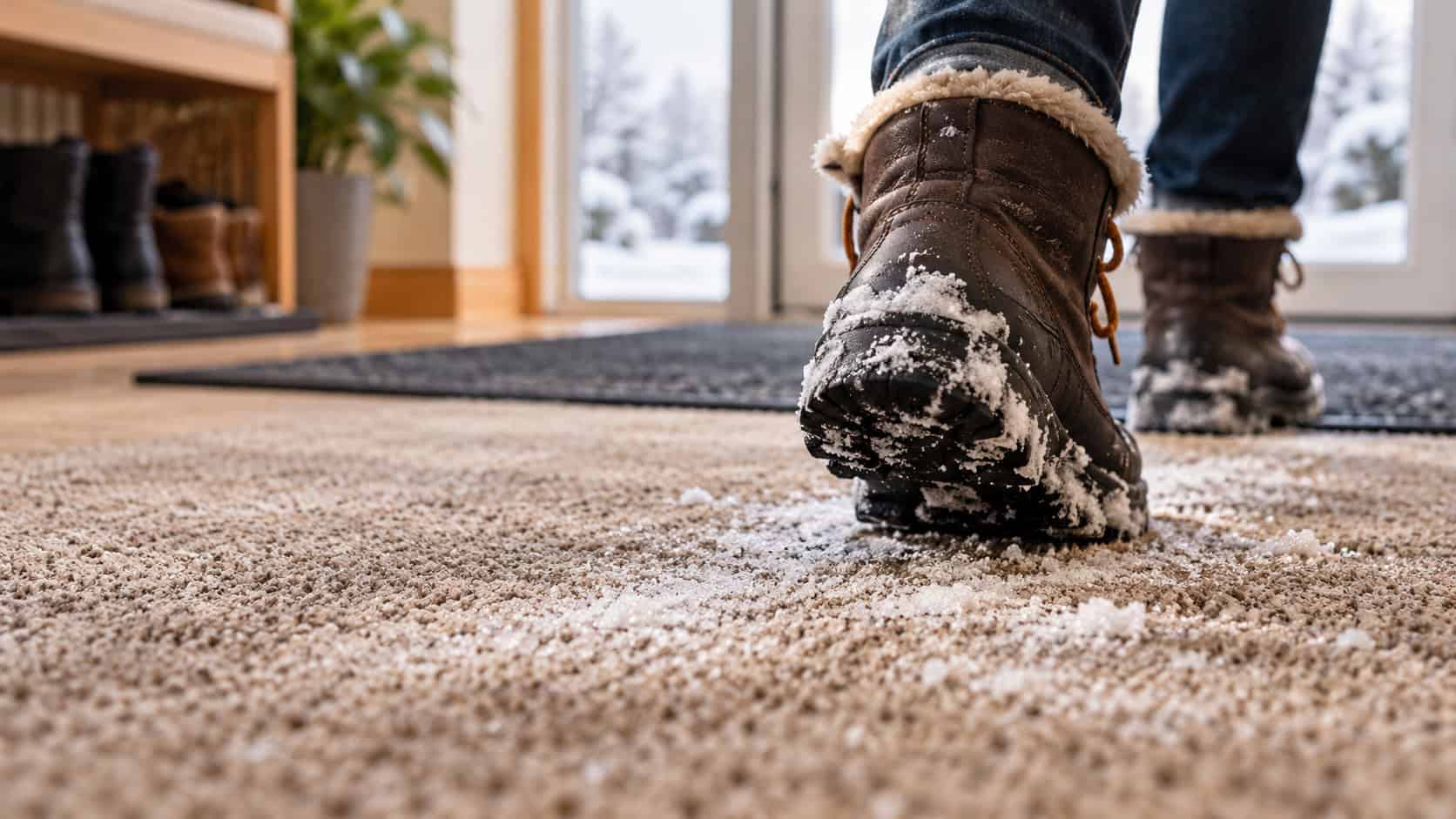
Winter in Northeast Ohio brings snow, ice, slush, and the de-icing materials used to keep sidewalks, parking lots, and roads safer. Unfortunately, much of that material eventually gets tracked indoors.
For homes and businesses, winter salt damage on carpets often begins near entrances and gradually spreads into hallways, stairs, waiting areas, offices, and other heavily traveled spaces. Once moisture from snow or slush dries, it can leave visible white or gray residue behind.
Sometimes the problem is mostly cosmetic. In heavier cases, repeated winter buildup can make carpet feel stiff, attract additional soil, and become increasingly difficult to remove through ordinary vacuuming.
Understanding winter salt damage on carpets is particularly useful in Northeast Ohio, where repeated snow events and the use of de-icing products can expose the same entrances and traffic areas to winter residue throughout the season.
The good news is that these problems are easier to manage when salt, moisture, and tracked-in soil are addressed before months of buildup accumulate.
Here are seven practical ways to prevent and deal with winter salt damage on carpets, along with signs that it may be time for professional cleaning.
Why Does Winter Salt Leave White Residue on Carpet?
Products used for winter de-icing are designed to work outdoors in freezing conditions. Depending on the property and municipality, tracked-in material may contain different salts, de-icers, sand, grit, dirt, and road residue.
When people walk through snow or treated pavement, small amounts of those materials can stick to shoes and boots.
Once indoors, the process is fairly simple:
- Snow and slush carry dissolved de-icing material onto the carpet.
- Moisture spreads into the carpet fibers.
- The water begins to evaporate.
- Mineral residue remains behind.
That remaining residue may appear as a white, gray, or chalky deposit.
If more snow and salt are tracked across the same area repeatedly, the buildup can return even after a quick surface cleaning.
This is why winter salt damage on carpets is often most noticeable near exterior doors and along predictable walking paths rather than evenly across an entire room.
Common Signs of Winter Salt Damage on Carpets
Not every winter carpet problem looks the same.
Some of the most common signs include:
- White or light-gray residue near entrances
- Stiff or crunchy-feeling carpet fibers
- Darkened traffic areas mixed with lighter salt residue
- Spots that appear to disappear when damp but return after drying
- Visible buildup around doorways
- Carpet that still looks dull after vacuuming
- Repeated soil accumulation along the same walking paths
One isolated white mark does not necessarily mean the carpet has suffered permanent damage.
Often, what people describe as winter salt damage on carpets is actually removable residue mixed with ordinary winter soil.
The important questions are how long the material has been present, how much has accumulated, and whether the carpet itself has also experienced physical wear.
Where Winter Salt Damage on Carpets Usually Appears
Salt and winter soil tend to follow foot traffic.
In a home, the highest-risk areas commonly include:
- Entryways
- Mudrooms
- Hallways
- Carpeted stairs
- Areas near garages
- Paths between entrances and living spaces
Commercial properties can experience the same problem on a larger scale.
Common trouble spots include:
- Main entrances
- Office lobbies
- Reception and waiting areas
- Hallways
- Areas around elevators
- Carpet immediately beyond entrance mats
- Frequently used employee entrances
This is one reason winter salt damage on carpets can become particularly noticeable in commercial buildings. Dozens or even hundreds of people may repeatedly follow the same path from a parking lot or sidewalk into the building.
The carpet closest to those traffic routes may therefore need more attention than areas farther inside the property.
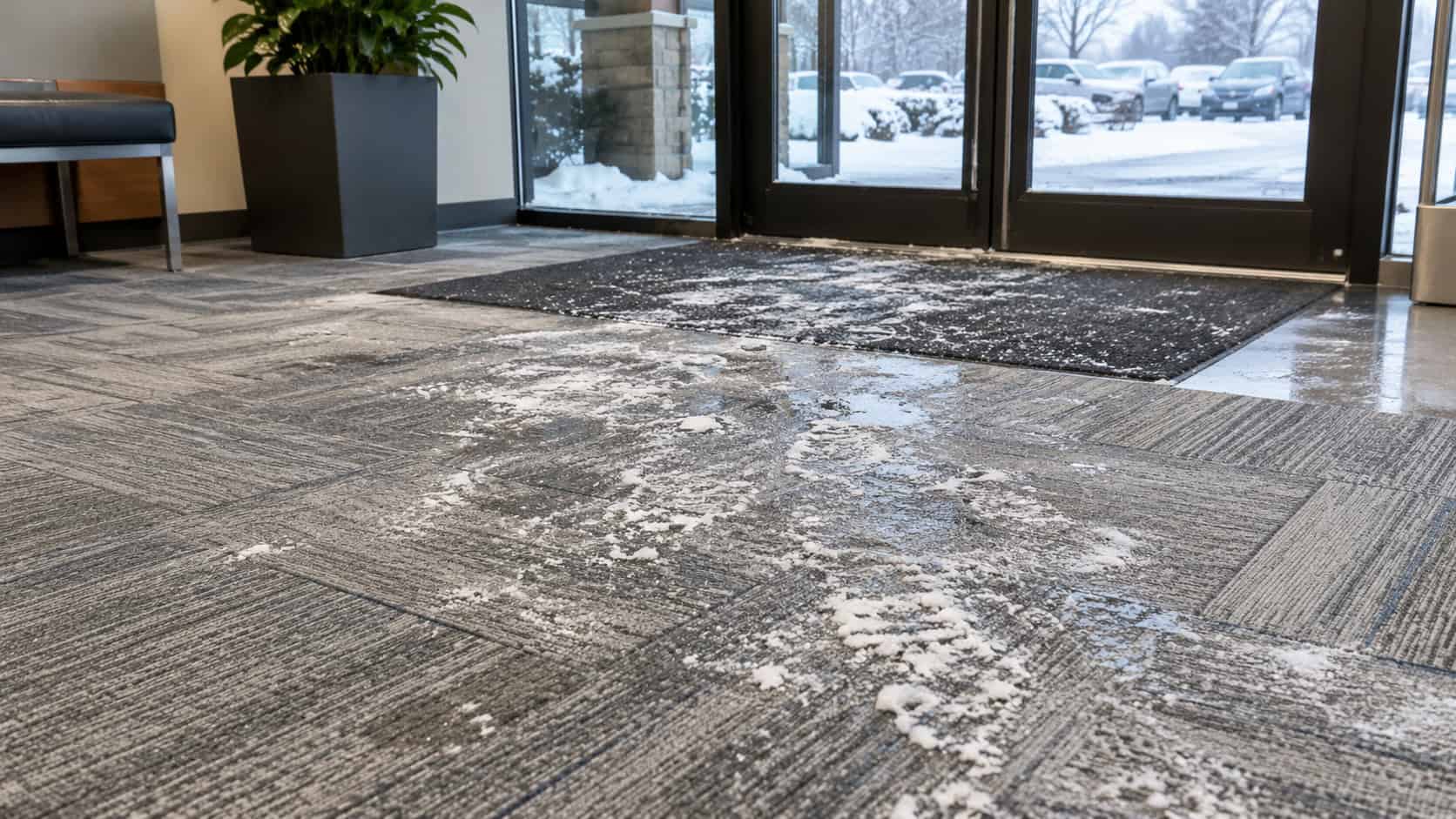
1. Use Effective Entrance Matting to Reduce Winter Salt Damage on Carpets
One of the simplest ways to reduce winter salt damage on carpets is to stop as much snow, moisture, salt, and grit as possible before it reaches the primary flooring.
A good entrance system gives people space to take several steps across matting before reaching the carpet.
Exterior mats can help remove larger particles from shoes, while interior absorbent mats can help capture moisture.
The mats themselves also need maintenance.
A saturated mat cannot continue absorbing moisture effectively, and a mat filled with dried salt and grit can eventually become another source of tracked-in material.
During active winter weather:
- Vacuum entrance mats regularly.
- Remove accumulated salt and grit.
- Allow wet mats to dry properly.
- Clean or replace heavily saturated mats when necessary.
- Make sure mats lie flat and do not create a trip hazard.
For commercial properties, matting can be especially valuable because many people may use the same entrance throughout the day.
Entrance mats will not eliminate winter salt damage on carpets entirely, but they can reduce how much winter material reaches surrounding flooring.
2. Vacuum High-Traffic Areas More Frequently
Vacuuming is particularly useful when winter residue is still dry and loose.
If dry salt crystals, grit, and soil remain on the carpet, continued foot traffic can push those particles farther into the pile.
Increasing vacuuming frequency around entrances and traffic lanes during winter can help remove loose material before it becomes more difficult to address.
Regular vacuuming is therefore one of the simplest ways to limit winter salt damage on carpets during periods of repeated snow and de-icer use.
You do not necessarily need to vacuum the entire building at the same frequency.
Focus attention where winter soil actually enters.
For example, a quiet private office may remain relatively clean while the hallway outside it receives repeated traffic from wet shoes and boots.
The same principle applies in a home. Carpet near an exterior door may need more frequent maintenance than a bedroom on another floor.
Regular vacuuming cannot remove every type of salt residue, particularly material that has dissolved and dried into the carpet.
However, it remains one of the most useful first lines of defense against winter buildup.
For additional industry guidance on professional carpet maintenance, the Carpet and Rug Institute provides carpet cleaning standards and resources.
3. Address Snow and Moisture Before It Dries Into the Carpet
Salt is only part of the winter problem.
Moisture helps carry de-icing residue farther into carpet fibers.
When someone tracks snow or slush indoors, dealing with the wet area promptly can reduce the amount of material left behind after drying.
Prompt moisture control can also help reduce winter salt damage on carpets by limiting how much dissolved residue spreads beyond the initial traffic area.
For a small wet area:
- Blot excess moisture rather than aggressively scrubbing.
- Avoid spreading the wet area farther across the carpet.
- Improve normal air circulation where practical.
- Keep additional foot traffic off the damp carpet when possible.
Aggressive rubbing is rarely helpful because it can spread the contamination and disturb carpet fibers.
It is also important not to soak the carpet while trying to clean it.
Too much liquid can move contamination deeper into the carpet and make drying more difficult.
Prompt moisture control is particularly important around exterior doors where fresh snow and slush may be tracked inside repeatedly throughout the day.
4. Remove Light Salt Residue Before It Becomes Heavy Buildup
A small amount of dried winter residue does not always require a full professional cleaning.
The safest first step is usually to remove as much loose material as possible with thorough vacuuming.
Addressing small areas early can keep winter salt damage on carpets from turning into a larger traffic-lane problem later in the season.
If visible residue remains, check the carpet manufacturer’s cleaning recommendations before applying a product.
When attempting a small spot treatment:
- Test the cleaning method in an inconspicuous area first.
- Avoid oversaturating the carpet.
- Blot rather than aggressively scrub.
- Use products intended for the specific carpet type.
- Allow the area to dry completely before evaluating the result.
One common mistake is judging a salt spot while the carpet is still wet.
Residue can become less visible when damp and then reappear as the carpet dries.
If the same white or gray deposit continues returning after drying, more residue may still be present within the carpet.
At that point, repeated surface treatment may not be the most effective approach.
5. Be Careful With DIY Treatments for Winter Salt Damage on Carpets
There are many online recipes for removing winter salt from carpet.
Vinegar, dish soap, laundry products, household detergents, and other mixtures are frequently recommended.
The problem is that not every cleaning solution is appropriate for every carpet.
Applying too much product can also create a second problem: cleaning residue.
If detergent is not adequately removed, the carpet may feel sticky and begin attracting soil more quickly.
Other common DIY issues include:
- Using too much water
- Scrubbing aggressively
- Creating visible rings around the treated area
- Spreading contamination beyond the original spot
- Leaving cleaning-product residue behind
- Repeatedly treating a spot without fully extracting the material
This does not mean every small winter carpet spot requires professional service.
It means homeowners and facility managers should be cautious about adding more chemicals to a carpet when they do not know how the fiber or backing will react.
When winter salt damage on carpets involves larger areas, recurring residue, or widespread traffic lanes, professional cleaning may be more practical than repeatedly treating individual spots.
6. Consider Professional Cleaning When Winter Salt Damage on Carpets Keeps Returning
Professional carpet cleaning can be useful when winter buildup extends beyond a small surface spot.
Orion Cleaning Solutions provides professional carpet steam cleaning for homes and commercial properties throughout Northeast Ohio.
Professional cleaning can help rinse and extract accumulated soil and removable residue from carpet instead of addressing only what is visible at the surface.
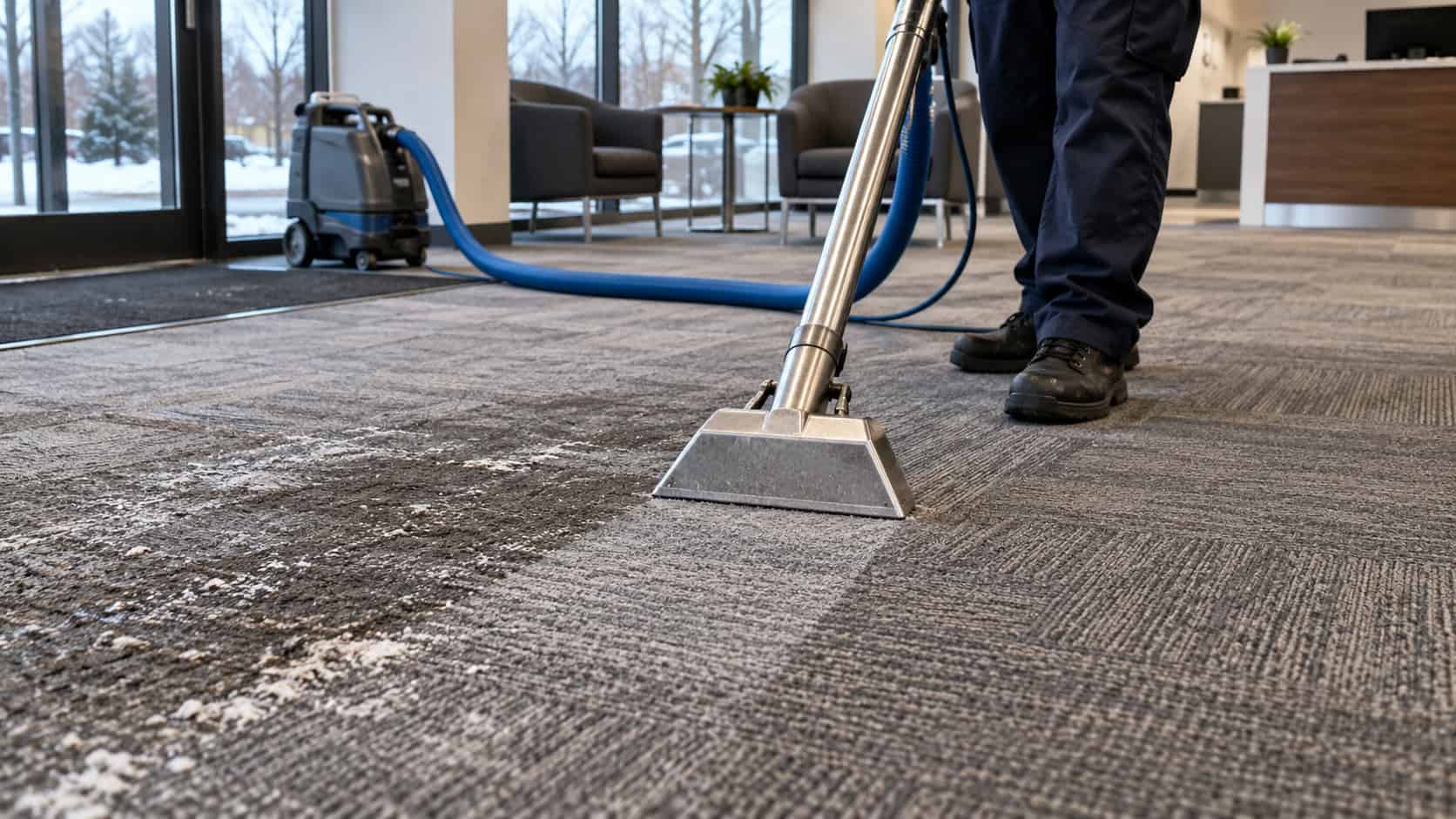
Professional service may be worth considering when winter salt damage on carpets repeatedly returns despite regular vacuuming or careful spot treatment.
Other signs include:
- White residue keeps returning after drying
- Entryways remain dull after vacuuming
- Carpet feels stiff or heavily soiled
- Winter soil extends through several traffic areas
- A large commercial entrance has experienced months of foot traffic
- Routine maintenance is no longer improving the carpet’s appearance
It is important to keep expectations realistic.
Professional cleaning cannot reverse permanent carpet wear or repair damaged fibers.
If a traffic lane has experienced significant physical wear, cleaning may improve soil-related discoloration without making the carpet identical to a low-traffic area.
The goal is to remove what is removable and accurately distinguish soil from permanent wear.
Learn more about Orion’s professional carpet cleaning services for residential and commercial properties.
7. Don’t Assume You Have to Wait Until Spring
A common approach to winter carpet care is to ignore the carpet until the snow season ends.
Sometimes waiting until spring makes sense.
But not always.
If a heavily used entrance has accumulated significant salt residue by January or February, there is no rule that says professional cleaning must wait several more months.
Addressing winter salt damage on carpets during the season may make sense when buildup has already become noticeable or routine maintenance is no longer keeping up.
Consider professional cleaning when:
- Salt buildup has become clearly visible
- High-traffic carpet looks significantly different from surrounding areas
- Residue repeatedly returns after routine cleaning
- The facility receives substantial customer or employee traffic
- The property needs to maintain a professional appearance throughout winter
Commercial properties may have an additional reason to clean during winter: they cannot simply stop operating until the weather improves.
Hotels, offices, medical facilities, apartment buildings, retail spaces, and other businesses continue receiving traffic every day.
That makes winter maintenance an ongoing process rather than a single spring cleanup.
Orion discusses this topic further in our guide to winter commercial carpet cleaning.
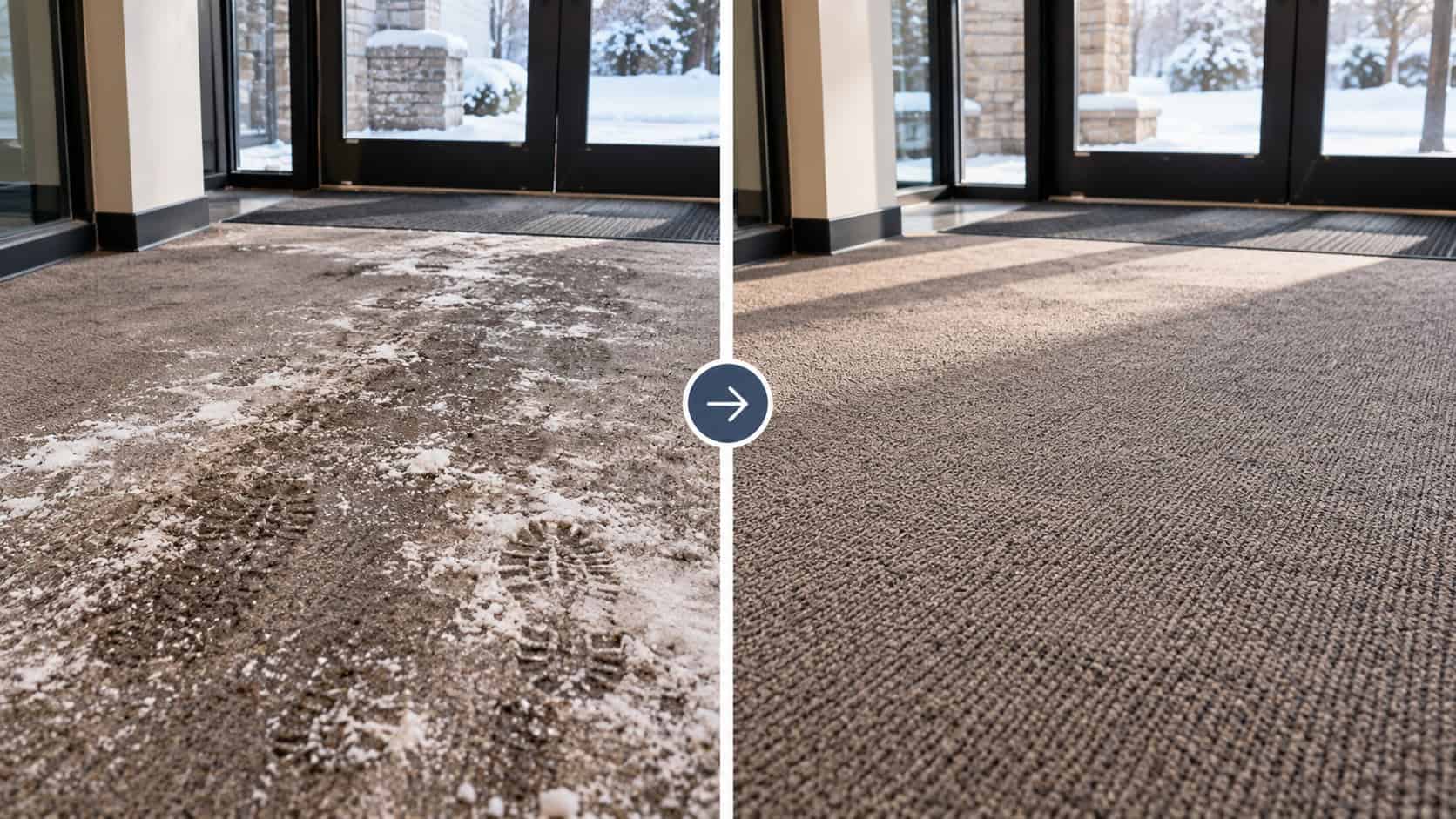
Residential vs. Commercial Winter Salt Damage on Carpets
The basic problem is the same in homes and businesses, but the scale can be very different.
Residential Carpet
In a home, winter salt damage on carpets is often concentrated near one or two entrances.
A household may be able to control much of the problem through:
- Removing shoes near the entrance
- Using interior and exterior mats
- Vacuuming regularly
- Drying wet areas promptly
- Cleaning small spots before they spread
Families with an attached garage may also see buildup along the path between the garage entrance and the main living area.
Commercial Carpet
Commercial properties often face a much higher volume of traffic.
Employees, customers, delivery drivers, tenants, and visitors may all track winter material through the same entrances.
This creates repeated accumulation in:
- Lobbies
- Hallways
- Reception areas
- Elevator approaches
- Main walking paths
For those buildings, preventing winter salt damage on carpets usually requires a combination of entrance matting, frequent vacuuming, spot response, and periodic professional cleaning.
Can Winter Salt Damage on Carpets Become Permanent?
Not every salt mark represents permanent damage.
Much of the white or gray material commonly seen during winter is residue that may be removable.
However, carpet can also experience normal physical wear in the same high-traffic areas where salt accumulates.
That is why a dark or discolored traffic lane does not automatically mean one specific substance caused the entire problem.
Several factors can overlap:
- Salt residue
- Road grit
- General soil
- Moisture
- Repeated foot traffic
- Existing carpet wear
Cleaning can address removable contamination.
It cannot replace worn fibers.
A professional evaluation can help determine whether winter salt damage on carpets is primarily removable residue or whether some of the visible difference is permanent wear.
Does Road Salt Make Carpet Feel Crunchy?
It can.
When dissolved minerals are carried into carpet by snow or moisture and then dry, residue may remain on or around the fibers.
Heavier residue can make carpet feel stiff or crunchy.
However, cleaning-product residue can produce a similar sensation.
If carpet becomes stiff after repeated DIY treatment, the problem may not be winter salt alone.
That is another reason proper rinsing and extraction matter when dealing with winter salt damage on carpets.
Why Does the White Residue Keep Coming Back?
This often happens because only the visible surface residue was removed.
Moisture temporarily changes the appearance of the carpet, making the spot appear to disappear.
As the area dries, remaining dissolved material can become visible again.
Repeated reappearance is a sign that additional residue may still need to be removed.
This recurring white buildup is one of the most recognizable forms of winter salt damage on carpets around heavily used entrances.
It is also a reason to avoid repeatedly adding more cleaning solution without adequately extracting what is already in the carpet.
How Often Should You Vacuum During Snowy Weather?
There is no single schedule for every home or commercial property.
Vacuuming frequency should reflect actual traffic and soil levels.
An entrance used by dozens of employees every day will usually need more attention than a low-use residential room.
During periods of snow and heavy de-icer use, inspect entrances and traffic areas frequently and vacuum them before visible buildup becomes significant.
The highest-use areas may need attention considerably more often than the rest of the carpet.
Frequent attention to these locations is one of the easiest ways to reduce winter salt damage on carpets before residue spreads farther into the building.
Can You Prevent All Winter Salt From Reaching Carpet?
Probably not.
In Northeast Ohio, some winter soil is almost inevitable in an actively used property.
The realistic objective is to reduce how much enters, remove loose material regularly, control moisture, and address buildup before it becomes severe.
Good entrance mats, regular vacuuming, sensible shoe practices, and timely cleaning can make a major difference in controlling winter salt damage on carpets.
Why Northeast Ohio Properties Need a Winter Carpet Plan
Winter conditions vary from year to year, but Northeast Ohio property owners know that snow, slush, freezing temperatures, and de-icing products are normal parts of the season.
That makes carpet maintenance particularly important near exterior entrances.
A good winter carpet plan does not have to be complicated.
For many properties, it consists of four basic steps:
- Capture as much material as possible at the entrance.
- Vacuum dry soil and grit regularly.
- Address wet areas and visible residue promptly.
- Schedule deeper professional cleaning when routine maintenance is no longer enough.
Following those steps can make winter salt damage on carpets easier to manage throughout the season instead of waiting for a heavily soiled entrance and expecting one quick spot treatment to solve months of accumulated winter traffic.
When Should You Call a Professional?
Consider professional carpet cleaning when:
- Salt residue covers a large area
- White deposits repeatedly return
- Carpet remains stiff after routine cleaning
- Hallways or entrances have developed significant traffic buildup
- DIY treatments have not worked
- You are concerned about damaging the carpet with additional cleaning products
- A commercial facility needs several areas cleaned at once
Professional service is particularly useful when winter salt damage on carpets extends beyond one small spot and becomes part of the overall condition of the flooring.
Maintaining Carpet After Professional Cleaning
After winter buildup has been professionally removed, prevention becomes important again.
Continue using entrance mats and vacuum them along with the surrounding carpet.
Monitor the first several feet beyond exterior entrances, because those areas often receive the greatest concentration of tracked-in soil.
If another major snow event occurs, do not assume the recently cleaned carpet is protected for the rest of the season.
New material can begin accumulating immediately.
For commercial properties, staff responsible for routine maintenance should pay particular attention to entryways and recurring traffic paths.
Professional cleaning and routine maintenance work best together when trying to control winter salt damage on carpets throughout an active Northeast Ohio winter.
Winter Salt Damage on Carpets Throughout Northeast Ohio
Orion Cleaning Solutions provides residential and commercial carpet cleaning throughout Cleveland and surrounding Northeast Ohio communities, including Westlake, Beachwood, Solon, Mayfield Heights, Chagrin Falls, Mentor, and Willoughby.
Winter conditions can affect every property differently, but entrance areas and other high-traffic spaces are consistently worth monitoring during snow and de-icing season.
For homes and businesses throughout the region, addressing winter salt damage on carpets early can make routine winter maintenance much easier.
Orion also provides other floor and cleaning services, which you can explore through our complete cleaning services and service area pages.
Final Thoughts: Preventing Winter Salt Damage on Carpets
Winter salt damage on carpets is easier to manage when it is addressed throughout the season rather than ignored until months of residue have accumulated.
Effective entrance matting, frequent vacuuming, prompt moisture control, and careful spot treatment can reduce the amount of salt and winter soil that remains in the carpet.
When winter salt damage on carpets keeps returning, traffic areas remain heavily soiled, or routine cleaning no longer produces a noticeable improvement, professional carpet cleaning may be the next step.
For Northeast Ohio homes and businesses, winter carpet maintenance is ultimately about keeping tracked-in snow, salt, grit, and moisture from becoming a larger problem.
If winter has left visible salt residue or heavy traffic buildup in your carpet, contact Orion Cleaning Solutions for a free estimate.