
Table of Contents
If you’re interested in professional commercial carpet cleaning, click here.
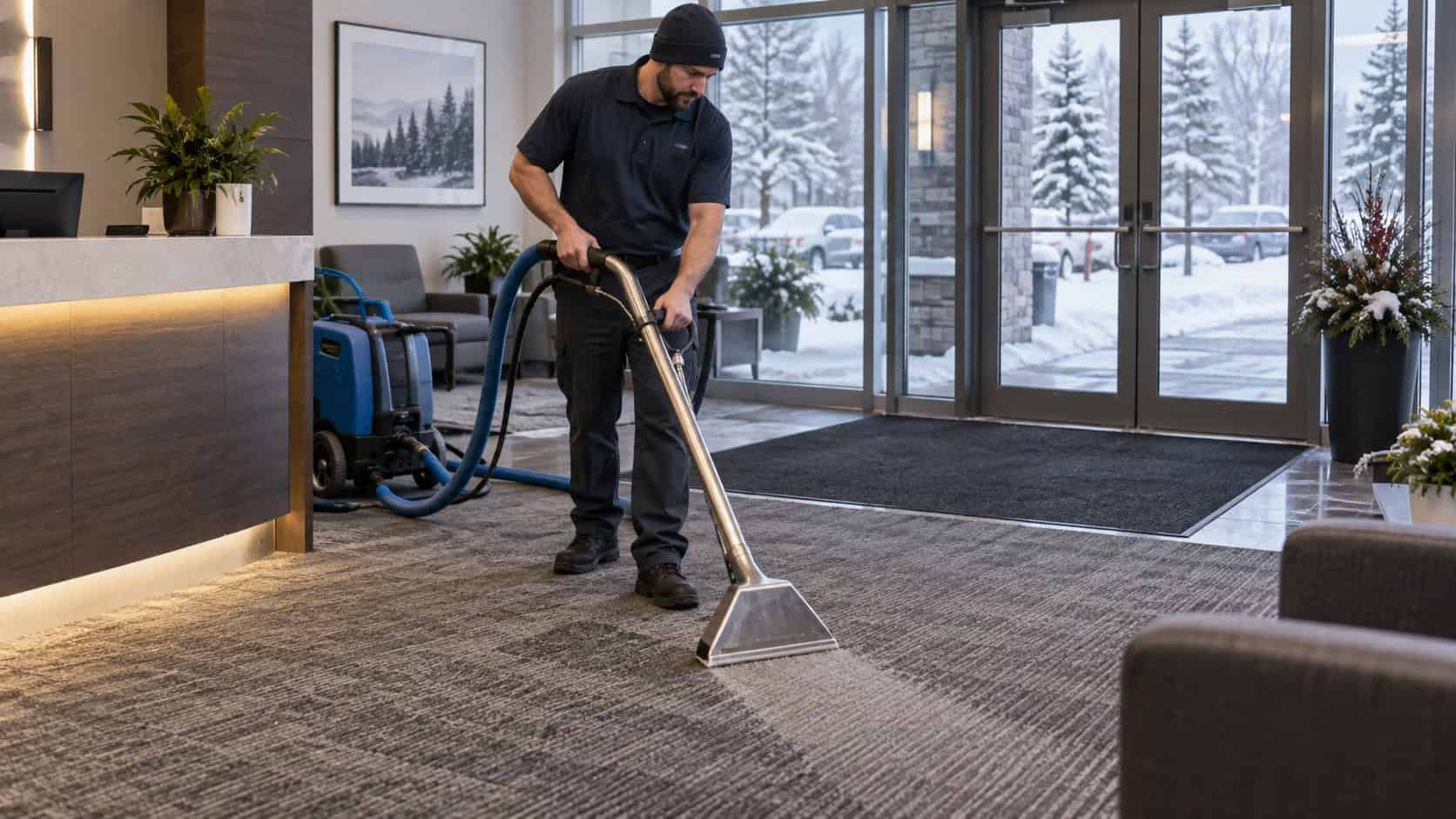
Winter in Northeast Ohio creates some of the toughest conditions of the year for commercial carpeting. Snow, slush, road salt, ice melt, mud, and moisture can all be tracked through entrances and gradually carried deeper into offices, medical facilities, apartment buildings, churches, schools, retail spaces, and other commercial properties.
Because of that, winter commercial carpet cleaning can be a useful part of a building’s maintenance plan rather than something businesses automatically postpone until spring.
There is a common assumption that carpet should only be professionally cleaned during warmer weather. In reality, modern commercial buildings are typically heated throughout the winter, and professional cleaning can be performed year-round when conditions inside the building allow proper drying.
More importantly, waiting until spring means salt, soil, and winter residue may remain in the carpet for months.
Professional cleaning during winter gives businesses an opportunity to remove that buildup while it is occurring, address heavily used entrances and traffic lanes, and keep customer-facing areas looking more presentable throughout the season.
That does not mean every commercial property should follow the same cleaning schedule. Some buildings may need professional carpet cleaning once a year, while heavily traveled facilities may require cleaning several times annually.
The Carpet and Rug Institute’s commercial carpet-maintenance standards emphasize that an effective program includes soil prevention, routine vacuuming, spot removal, interim maintenance, and scheduled deep cleaning rather than relying on a single cleaning event.
For businesses in Cleveland and the surrounding suburbs, winter commercial carpet cleaning can therefore be particularly valuable when winter weather is placing the greatest strain on entrances, hallways, reception areas, and other carpeted spaces.
Here are seven reasons businesses may benefit from professional carpet cleaning during winter.
1. Winter Commercial Carpet Cleaning Helps Remove Road Salt and Ice Melt
One of the biggest winter carpet problems in Northeast Ohio is road salt and ice-melting material.
These products are essential for keeping parking lots, sidewalks, steps, and entrances safer during freezing weather, but they rarely remain outdoors.
Employees, customers, patients, tenants, delivery drivers, and visitors carry small amounts into the building every time they walk through the entrance.
Some residue is captured by entrance mats.
Some reaches the carpet.
As wet shoes dry, salt residue can become visible as light-colored or chalky marks. Repeated foot traffic can then carry that material farther into the building.
The Carpet and Rug Institute notes that areas receiving large amounts of granular soil or salt and ice-melt material can gradually develop a dull appearance as abrasive particles affect carpet fibers. Frequent vacuuming helps reduce this problem, but deeper cleaning is also part of a complete maintenance program.
The Carpet and Rug Institute also emphasizes soil prevention, regular vacuuming, and scheduled deep cleaning as parts of a complete commercial carpet maintenance program.
This is one of the strongest reasons to consider winter commercial carpet cleaning instead of waiting until all the snow has disappeared.
Cleaning can help address residue in areas such as entranceways, vestibules, reception spaces, hallways, elevator areas, waiting rooms, and other heavily traveled routes.
The goal is not simply to make the carpet look better for a day.
Removing accumulated winter soil can help prevent the building from carrying months of buildup through the remainder of the season.
2. Cleaning During Winter Addresses Soil Before Months of Additional Traffic
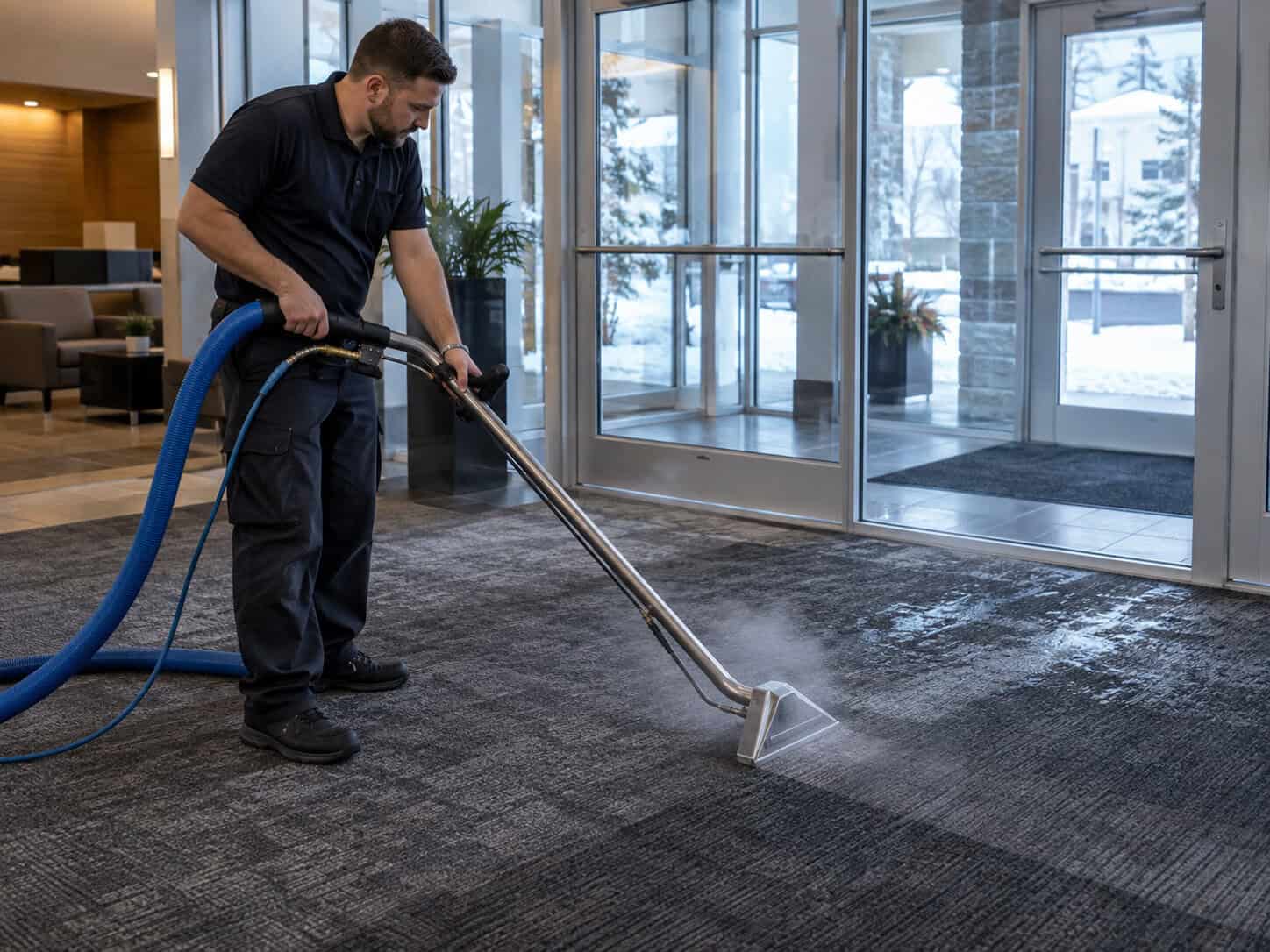
Winter commercial carpet cleaning can address buildup before an entire season of soil accumulates.
The buildup happens gradually.
Imagine a busy office entrance during January.
People walk through snow and salt in the parking lot, wipe their shoes briefly on an entrance mat, and continue into the building.
Some soil remains on the mat.
Some reaches the carpet immediately beyond it.
The next person follows the same path.
This process can repeat hundreds or thousands of times.
If the carpet is not professionally cleaned until late spring, material tracked inside during December or January may remain there for several months.
Winter commercial carpet cleaning gives businesses the option of interrupting that cycle.
Instead of allowing winter soil to continue accumulating, property managers can schedule a deeper cleaning during the season and then continue routine maintenance afterward.
This can be particularly useful in properties that experience consistent public traffic, including medical offices, apartment common areas, professional buildings, schools, churches, and facilities with multiple exterior entrances.
The heavier the traffic, the more important it becomes to evaluate the carpet based on its actual condition rather than relying exclusively on a calendar.
A midwinter cleaning may make sense for one property while another building may remain in good condition until spring.
The right schedule depends on the facility.
3. Winter Cleaning Can Improve the Appearance of Entrances and High-Traffic Areas
Carpet rarely soils evenly.
A conference room used twice a week may remain relatively clean while the hallway outside receives constant traffic.
A private office may show little visible soil while the reception area near the front door becomes noticeably darker.
Winter commercial carpet cleaning can help address these high-traffic areas while seasonal soil is still accumulating.
High-use areas may include main entrances, reception areas, waiting rooms, hallways, elevator landings, stair entrances, employee entrances, and paths between frequently used departments.
When winter residue combines with normal commercial traffic, these sections can begin looking significantly different from the surrounding carpet.
Winter commercial carpet cleaning provides an opportunity to focus on these high-use areas before the difference becomes more noticeable.
Professional cleaners can evaluate traffic patterns and determine which areas need additional attention.
Depending on the condition of the carpet, this may include appropriate pretreatment, spot treatment, agitation when necessary, and professional extraction.
It is important to separate soil from permanent wear.
Professional cleaning can remove removable soil, but it cannot reverse permanently worn fibers, fading, crushing, or physical carpet damage.
However, cleaning the carpet can help property managers better determine what is dirt and what is actual wear.
For businesses that regularly receive customers or clients, maintaining entrances and reception spaces can be especially important because these areas contribute to the first impression of the facility.
4. Professional Cleaning Goes Beyond Routine Winter Vacuuming
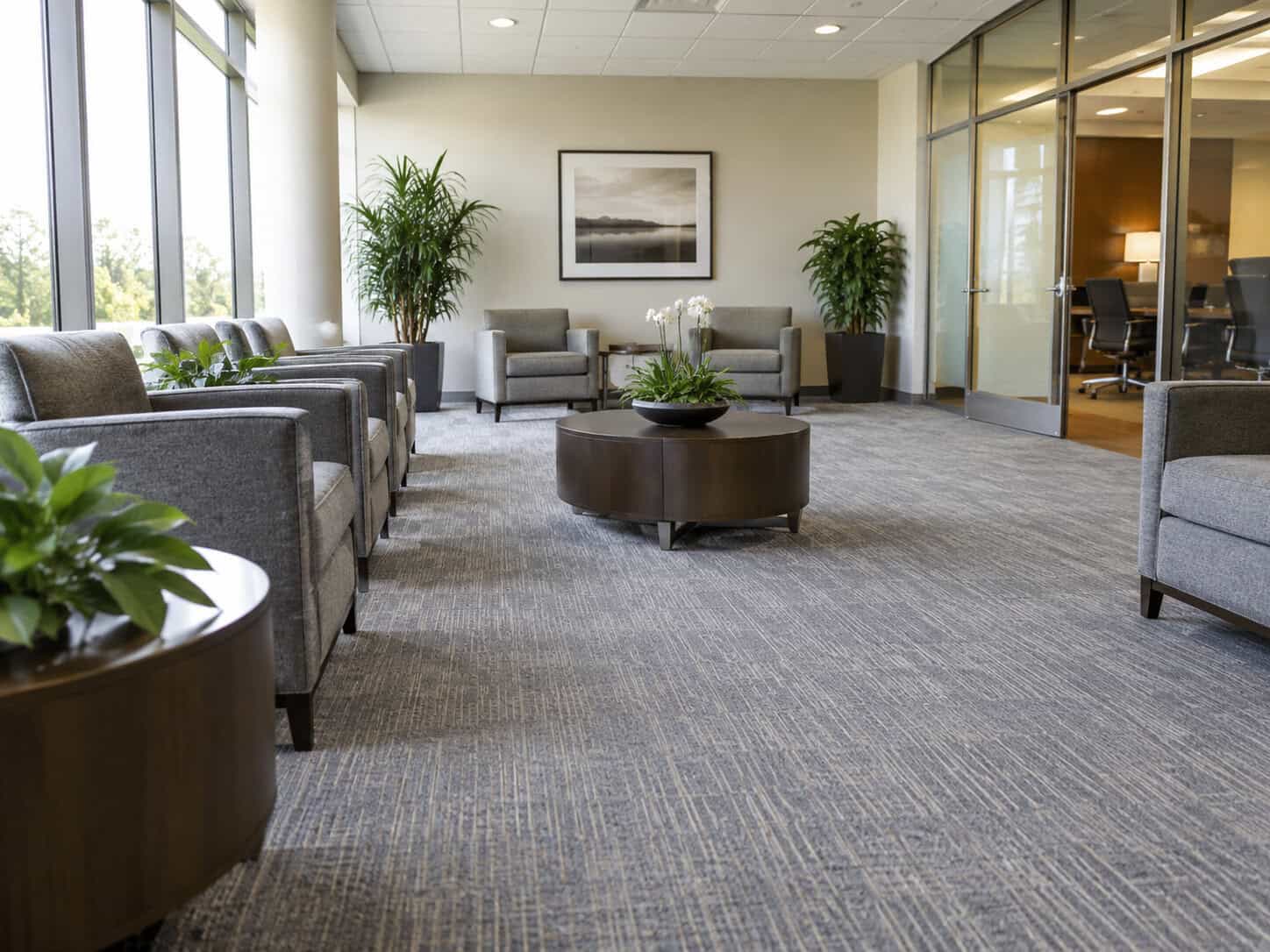
Regular vacuuming supports winter commercial carpet cleaning by controlling loose soil between professional services.
During winter, businesses may need to increase vacuuming frequency near exterior entrances because those areas receive more dry soil and granular material.
However, vacuuming and professional cleaning serve different purposes.
Vacuuming removes loose dry soil.
Professional carpet cleaning can address deeper soil, residue, spots, and buildup that routine vacuuming may leave behind.
A professional cleaning process may begin with an inspection of the carpet and heavily traveled areas.
This allows the technician to identify visible traffic patterns, spots, stains, residue, and areas that may require additional treatment.
A suitable pretreatment may then be used to loosen accumulated soil.
Areas with heavier buildup may require additional agitation before extraction.
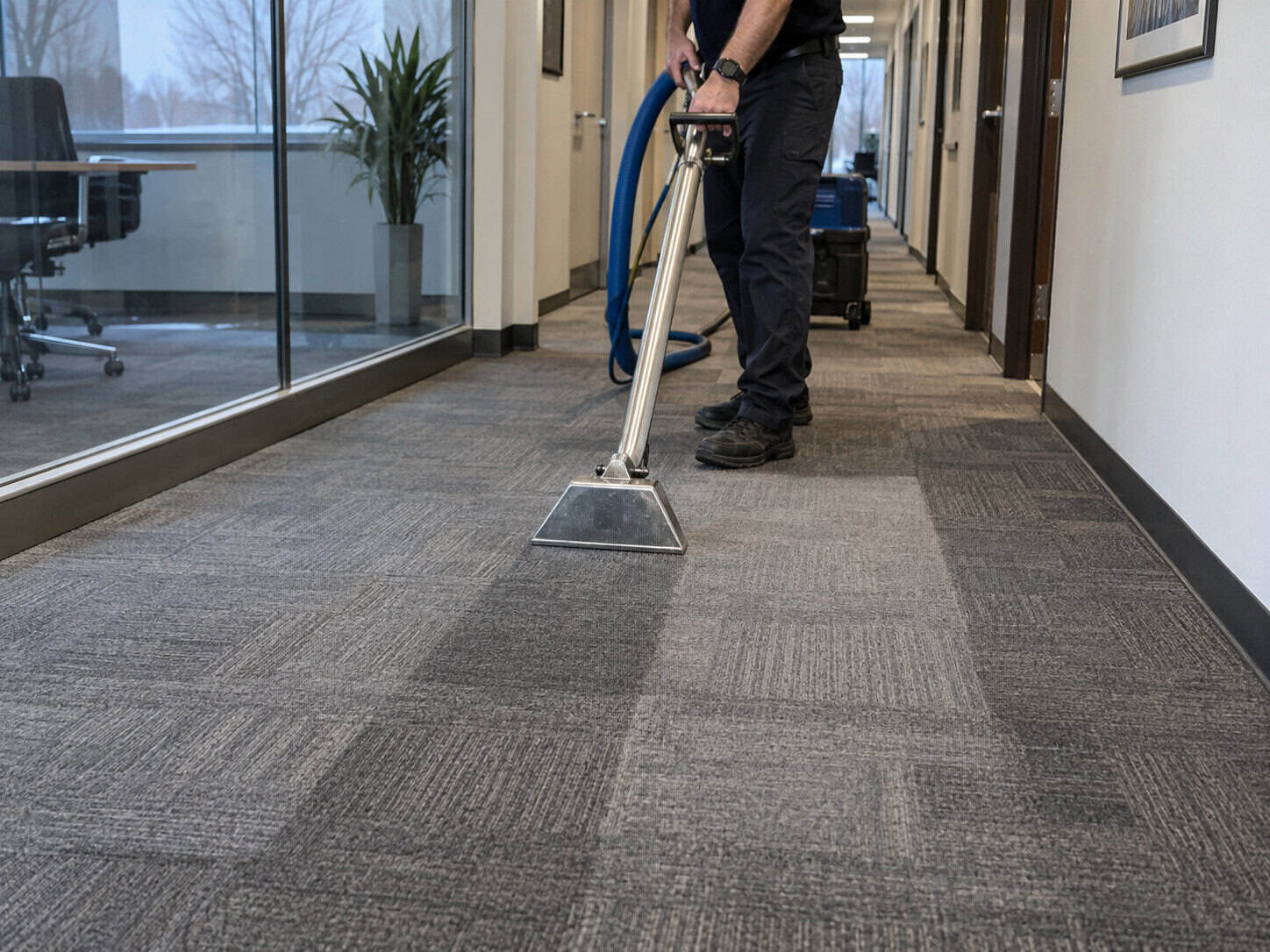
Professional extraction then helps rinse the carpet and remove loosened soil, cleaning solution, and moisture.
Winter commercial carpet cleaning works best when it complements routine maintenance rather than replacing it.
After professional cleaning, businesses should continue regular vacuuming, entrance-mat maintenance, and prompt spot removal.
The Carpet and Rug Institute identifies routine vacuuming, spot removal, interim cleaning, deep cleaning, and soil prevention as separate parts of an effective commercial carpet-maintenance program.
In other words, no single cleaning method does everything.
The best results usually come from combining routine maintenance with periodic professional cleaning.
5. Winter Carpet Cleaning Can Be Practical in Heated Commercial Buildings
One concern businesses sometimes have about winter carpet cleaning is drying time.
It seems logical to assume that carpet will only dry properly when outdoor temperatures are warm.
However, commercial carpet is normally drying in the indoor environment, not outside.
Winter commercial carpet cleaning can still be practical when the building is heated and provides suitable airflow for drying.
A heated building with appropriate airflow can often provide good conditions for professional cleaning during winter.
Actual drying time depends on many factors, including carpet construction, cleaning method, indoor temperature, humidity, ventilation, airflow, the amount of moisture used during cleaning, and how much moisture is recovered during extraction.
For that reason, businesses should avoid assuming a universal drying time.
Winter commercial carpet cleaning should be planned around the conditions of the particular facility.
Professional extraction equipment is designed to recover a significant portion of the moisture used during cleaning.
Air movement and the building’s HVAC system may also support the drying process.
Businesses can further reduce disruption by scheduling cleaning during periods when certain areas receive less traffic.
For example, an office may schedule cleaning after employees leave for the day, while another facility may choose a weekend or lower-traffic period.
The important point is that winter itself does not automatically make professional carpet cleaning impractical.
The indoor environment and the cleaning process matter much more than the outdoor temperature alone.
6. Winter Cleaning Can Fit Into a Year-Round Maintenance Plan
Commercial carpet should not be maintained according to a single universal schedule.
The U.S. Environmental Protection Agency does not prescribe one specific carpet-cleaning frequency for every building. Instead, it recommends following manufacturer guidance and recognized industry standards.
That is important because commercial properties vary enormously.
A small professional office with ten employees does not experience the same conditions as a medical facility with hundreds of visitors.
A private corporate office does not have the same traffic as an apartment hallway.
A church may experience limited weekday use but very heavy weekend traffic.
A good maintenance schedule should consider factors such as traffic volume, number of entrances, type of business, outdoor conditions, routine vacuuming, carpet color, entrance matting, spills, and the expectations of the property.
For some facilities, winter commercial carpet cleaning may be one of several scheduled professional cleanings throughout the year.
For others, winter may simply be the right time to address entrances and other heavily used sections while the rest of the carpet remains on a different schedule.
Businesses can also combine winter cleaning with other seasonal maintenance.
For example, a facility might perform a winter cleaning to address salt and slush, then schedule another cleaning in spring or fall depending on traffic and carpet condition.
If you are deciding how frequently your facility should schedule professional service, Orion’s guide on how often office carpets should be professionally cleaned explains several factors that can influence the schedule.
The calendar can provide convenient maintenance checkpoints, but the condition of the carpet should ultimately determine when cleaning is needed.
Learn more about how often office carpets should be professionally cleaned.
7. Cleaning During Winter Helps Prevent the “Wait Until Spring” Problem
One of the simplest advantages of winter commercial carpet cleaning is that businesses do not have to spend the entire winter looking at increasingly dirty carpet.
Waiting until spring can make sense for some facilities.
But it should not become an automatic rule.
If entrance carpeting becomes visibly covered with salt residue in January, waiting several additional months simply because spring has not arrived may not be necessary.
The same applies to stains, traffic lanes, and other buildup.
Commercial facilities need to remain presentable throughout the year.
Customers, tenants, employees, patients, visitors, and vendors do not stop entering the building because it is winter.
A facility that welcomes people every day may benefit from addressing obvious carpet problems when they occur.
Winter commercial carpet cleaning gives property managers another maintenance option.
Rather than postponing every major cleaning until warm weather, businesses can respond to the condition of the carpet.
Then, when spring arrives, the facility is not necessarily starting with an entire winter’s worth of accumulated soil.
Spring cleaning may still be useful.
The difference is that it becomes part of ongoing maintenance rather than an emergency cleanup after several months of neglect.
What Types of Commercial Properties Can Benefit From Winter Cleaning?
Winter commercial carpet cleaning can be useful across many types of commercial properties, although the exact cleaning needs will vary.
Office buildings often contain carpeted reception areas, conference rooms, hallways, workspaces, and private offices. Entrance areas may accumulate significantly more winter soil than sections farther inside.
Medical and wellness facilities may experience constant foot traffic from patients, staff, and visitors. Waiting areas and corridors can require particular attention.
Apartment and multi-family buildings may have carpeted hallways, common areas, elevator landings, and entrances that are used throughout the day.
Churches and worship facilities can include carpeted sanctuaries, classrooms, gathering areas, hallways, stages, and offices.
Schools, training facilities, and educational buildings often experience high levels of traffic and may need different maintenance frequencies for different portions of the building.
Professional offices, financial institutions, retail-adjacent businesses, and other customer-facing properties can also benefit from keeping carpeted areas presentable during winter.
The important point is that winter commercial carpet cleaning should be based on actual facility needs rather than assuming that every commercial property needs the exact same service at the exact same time.
Why Entrance Matting Still Matters
Professional carpet cleaning is only one part of controlling winter soil.
Entrance mats can significantly reduce the amount of dirt and moisture reaching permanent carpet.
During winter, buildings should pay particular attention to exterior and interior walk-off areas.
A mat that is saturated with water, salt, and debris becomes less effective.
Mats should therefore be vacuumed, cleaned, exchanged, or maintained according to their condition and manufacturer recommendations.
EPA guidance for facilities also emphasizes using walk-off mats at building entrances to help trap dirt and moisture before it reaches interior flooring.
Entrance maintenance becomes even more effective when combined with regular vacuuming and professional cleaning.
Think of the system in layers.
The entrance mat captures as much material as possible.
Routine vacuuming removes dry soil that gets past the mat.
Spot cleaning addresses spills and localized problems.
Professional carpet cleaning removes deeper accumulated material.
Each part serves a different purpose.
Should You Clean Commercial Carpet During Active Snow Season?
Yes, it can make sense.
Winter commercial carpet cleaning allows businesses to remove accumulated residue without waiting for the snow season to end.
Some businesses assume that cleaning carpet while snow remains on the ground is pointless because people will immediately begin tracking soil inside again.
But the same argument could be made about almost any type of maintenance.
Floors are still cleaned even though people will walk on them again.
Windows are cleaned even though they will eventually become dirty again.
The goal is not to keep carpet permanently untouched.
The goal is to manage soil before buildup becomes excessive.
Winter commercial carpet cleaning can be especially useful when the facility has already accumulated significant residue during the first half of the season.
After cleaning, effective entrance matting and more frequent vacuuming can help maintain the results.
A facility that receives unusually heavy winter traffic may even benefit from concentrating professional cleaning on key traffic areas rather than waiting for the entire building to become heavily soiled.
Winter Commercial Carpet Cleaning vs. Spring Cleaning
Winter and spring cleaning are not competing strategies.
They solve different maintenance problems.
Winter cleaning addresses salt, soil, traffic buildup, and spots while winter conditions are still occurring.
Spring cleaning can provide a broader reset after the season ends.
Some commercial facilities may only need one of those services.
Others may benefit from both.
For example, a busy building might schedule winter commercial carpet cleaning for entrances, main hallways, and reception areas during the season, followed by a more comprehensive cleaning in spring.
Another property with lighter traffic may be able to wait until spring without any significant problem.
This is why Orion’s newer guide to commercial carpet cleaning in spring and fall focuses on seasonal maintenance checkpoints rather than declaring one season universally better than another.
The best time to clean is often when the condition of the carpet indicates that professional cleaning is needed.
Maintaining Commercial Carpet Between Winter Cleanings
Businesses can make professional cleaning more effective by maintaining the carpet properly between appointments.
During winter, the most important priorities are controlling soil at entrances, vacuuming high-traffic areas frequently, treating spots promptly, and watching for visible salt accumulation.
Pay particular attention to the first several yards of carpet beyond exterior entrances.
These areas usually receive the highest concentration of outdoor soil.
Also compare high-traffic carpet with less-used sections near walls or under furniture.
If traffic areas are becoming significantly darker, that may indicate accumulating soil or physical wear.
Spills should be addressed promptly using appropriate products and techniques.
Aggressive scrubbing is not always the best approach because it may spread a spill or alter the carpet texture.
Regular maintenance will not eliminate the need for professional cleaning, but it can slow soil accumulation and help prevent isolated problems from becoming larger ones.
Routine vacuuming and entrance maintenance can also help preserve the results of winter commercial carpet cleaning.
How Orion Approaches Commercial Carpet Cleaning
Every commercial facility is different, so carpet cleaning should begin with an evaluation of the space rather than applying the same process automatically to every building.
A professional carpet-cleaning project may include inspection of the carpet, identification of high-traffic areas, pretreatment of appropriate sections, spot treatment, additional agitation when required, professional extraction, and attention to entrances and major traffic paths.
The exact process depends on the carpet construction, condition, soil level, and agreed scope of work.
Commercial cleaning also requires consideration of building operations.
Businesses may need certain hallways to remain open, specific offices cleaned first, entrances handled in stages, or work scheduled outside normal operating hours.
Planning the project around the facility can reduce disruption while still allowing the carpet to receive appropriate attention.
Orion Cleaning Solutions provides commercial carpet cleaning throughout Cleveland and surrounding communities, including Beachwood, Solon, Mayfield Heights, Mayfield Village, Mentor, Willoughby, and other nearby areas.
Businesses can also explore Orion’s commercial cleaning services for additional facility-cleaning needs.
Frequently Asked Questions
Is winter a bad time to professionally clean commercial carpet?
No. Winter commercial carpet cleaning can be a practical time when the building provides appropriate indoor temperature, ventilation, and drying conditions. It can also allow businesses to remove salt and winter soil instead of leaving it in the carpet until spring.
Does road salt damage commercial carpet?
Tracked-in salt and granular material can contribute to visible residue and an increasingly dull appearance. Abrasive particles can also affect the surface appearance of carpet fibers over time, which is one reason entrance maintenance and regular soil removal are important.
Will carpet dry properly during winter?
It can. Drying depends primarily on indoor conditions, carpet construction, airflow, humidity, cleaning method, and moisture recovery rather than outdoor temperature alone. Exact drying time varies by building and cleaning situation.
How often should a commercial property clean its carpet?
There is no single schedule that applies to every facility. Traffic volume, business type, number of occupants, carpet condition, entrance matting, vacuuming frequency, and seasonal soil all influence how often professional cleaning may be appropriate.
Should businesses wait until spring to remove winter salt?
Not necessarily. If salt residue and tracked-in soil are already affecting the appearance of the carpet, cleaning during winter can address the problem while the season is still underway.
Can only entrances and high-traffic areas be cleaned during winter?
In some facilities, targeted cleaning may make sense. The appropriate scope depends on carpet condition and whether cleaning selected areas would create an obvious appearance difference compared with surrounding carpet.
Final Thoughts
Winter places unique demands on commercial carpeting in Northeast Ohio.
Snow, road salt, slush, mud, moisture, and repeated foot traffic can create visible buildup in entrances, hallways, reception areas, and other busy parts of a building.
Businesses do not necessarily need to wait until spring to address those problems.
Winter commercial carpet cleaning can help remove seasonal residue while it is accumulating, improve the appearance of high-traffic areas, complement routine vacuuming, and keep customer-facing spaces more presentable throughout the season.
The right schedule still depends on the individual property.
Some commercial facilities may need professional cleaning several times each year. Others may need it less frequently.
The most effective approach is to combine soil prevention, entrance matting, regular vacuuming, spot treatment, and scheduled professional cleaning based on the actual condition of the carpet.
For Cleveland-area businesses, winter commercial carpet cleaning can be one useful part of that year-round maintenance strategy.
Orion Cleaning Solutions provides professional commercial carpet cleaning for offices, medical facilities, churches, apartment common areas, schools, professional buildings, and other qualifying commercial properties throughout Cleveland and surrounding communities.
If winter salt, traffic lanes, stains, or embedded soil are beginning to affect your facility’s carpet, Orion can evaluate the space and recommend an appropriate cleaning scope.